

Sewer Line Repair in Houston, TX: A 2026 Homeowner’s Guide

Sewer Line Repair in Houston, TX: A 2026 Homeowner’s Guide

Sewer Line Repair in Houston, TX: A 2026 Homeowner’s Guide

Sewer Line Repair in Houston, TX: A 2026 Homeowner's Guide

Sewer line repair fixes a damaged section of the underground pipe that carries wastewater from your home to the city’s sewer main. In Houston, most residential sewer trouble traces back to the same source, expansive clay soil shifting under slab-on-grade foundations and stressing the rigid pipe below. The right repair depends on what a camera inspection finds. A single cracked joint can often be handled with a targeted spot repair, while a collapsed or badly bellied line may need a section replaced or relined. The repair scope should follow the diagnosis.

We have served Houston homeowners since 1956, and at Spring Branch AC we approach sewer work the way we approach HVAC: open the system up, confirm the real problem, and repair what can be repaired before anyone talks about replacement. For the under-slab failures common in Houston’s slab-foundation homes, our crews hand-dig tunnels beneath the slab to reach and repair the damaged pipe from the outside, which keeps the demolition out of your living space. Below, we cover what causes sewer line damage here, how to spot it early, how the repair is actually done, what it costs, and how to tell whether the line is your responsibility or the city’s.

What a sewer line repair actually involves

Your sewer lateral is the privately owned pipe that runs from your home’s plumbing out to the city’s main line. It usually sits under the yard, and in many Houston homes part of it runs beneath the concrete slab. When that pipe cracks, separates at a joint, or sags into a low spot, wastewater either backs up into the house or leaks into the soil underneath.

Repair means fixing or replacing the failed portion of that pipe rather than tearing out the whole line. Depending on the diagnosis, that can mean a localized spot repair, a trenchless reline that creates a new pipe inside the old one, or digging and replacing a damaged section. The first step is always the same: see the actual condition of the pipe before choosing a method. Sewer work sits within our broader sewer and drain services, and every one of those jobs starts with a look inside the line.

Why sewer lines fail in Houston homes

Houston is hard on underground pipe. A few specific local factors do most of the damage.

Shifting clay soil and slab foundations
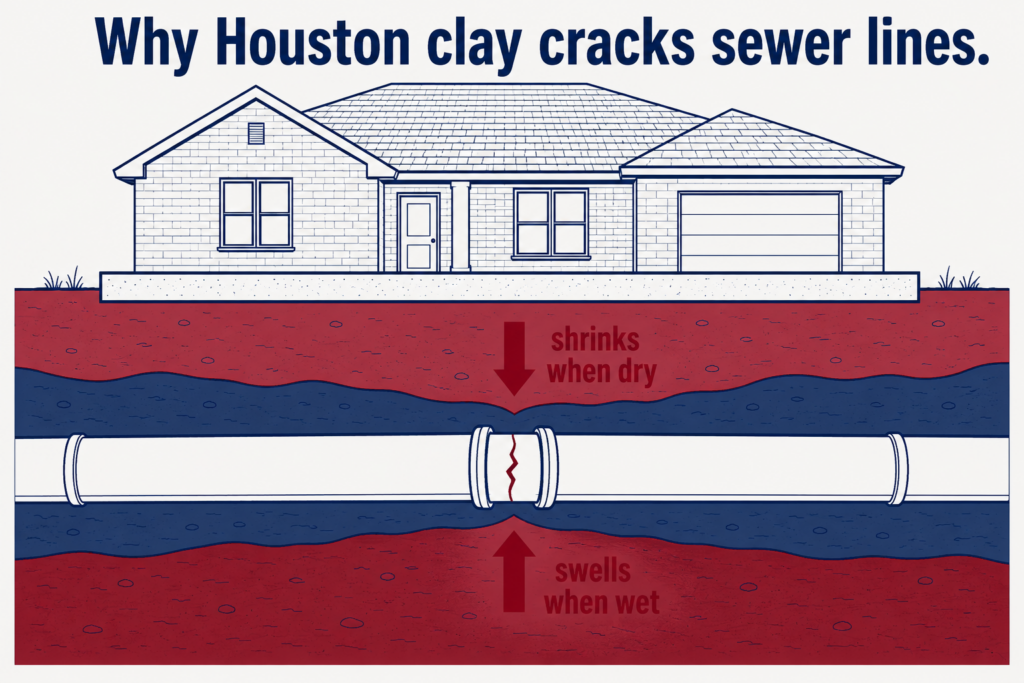
The Greater Houston area sits on expansive clay, the kind that swells when it absorbs water and shrinks when it dries out. Through a wet Gulf Coast spring and a dry late summer, that soil expands and contracts over and over. Rigid sewer pipe cannot flex with it.

Over the years, that movement pulls pipe joints apart and creates low spots, known in the trade as bellies, where wastewater pools instead of draining. Eventually the pipe wall fractures. In slab-on-grade homes, the same soil movement that cracks a foundation also cracks the drain lines running beneath it. Once a pipe leaks, it saturates the surrounding clay, the clay swells more, and the next failure comes faster.

Tree roots in the line

Mature trees are the second common culprit. Roots chase moisture, and a sewer line full of warm water is a target. A root finds its way in through a small crack or a loose joint, then grows until it slows the flow or breaks the pipe open. One intrusion at a single joint is often a repair. Roots running the full length of an older line are a different situation, which we cover in the repair-versus-replace section below.

Grease, wipes, and everyday clogs
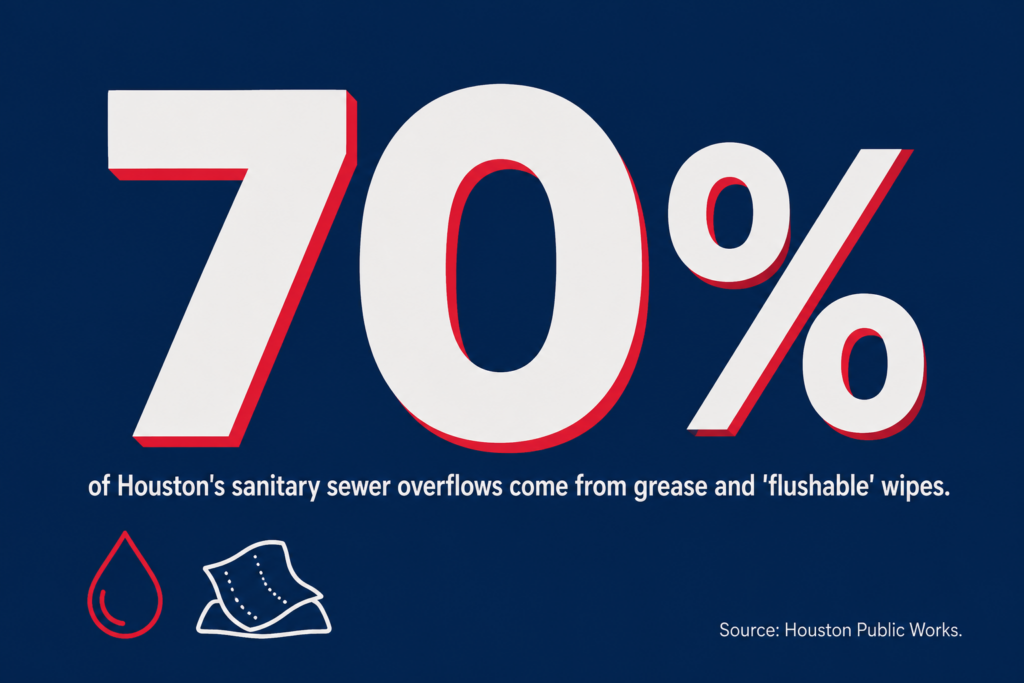
Not every sewer problem is structural. Plenty are blockages. According to Houston Public Works, about 70 percent of the city’s sanitary sewer overflows come from fats, oils, and grease combining with so-called flushable wipes, which do not break down the way toilet paper does. The city’s Protect Our Pipes guidance is blunt: flush only the three P’s, which are pee, poo, and paper, and pour cooled grease into a container for the trash.

A clog and a cracked pipe call for different fixes. Clearing a stoppage with drain cleaning gets the line flowing again, but it does not repair a broken pipe. That is one more reason a camera inspection matters. It tells you whether you are looking at a blockage you can clear or structural damage you need to repair.

Warning signs you may need sewer line repair

Sewer problems usually show themselves before a full backup. Watch for:

  • Several drains running slow at the same time, especially on the lowest floor
  • Gurgling from toilets or drains when you run water somewhere else in the house
  • A sewage smell inside the home or out in the yard
  • Wastewater backing up into tubs, showers, or floor drains
  • Soggy spots, sunken ground, or an unusually green patch of lawn over the line
  • Clogs that keep coming back soon after they are cleared

One or two of these can point to a simple clog. Several at once, or any sewage backup, points to a line problem worth inspecting.

How a sewer line problem gets diagnosed
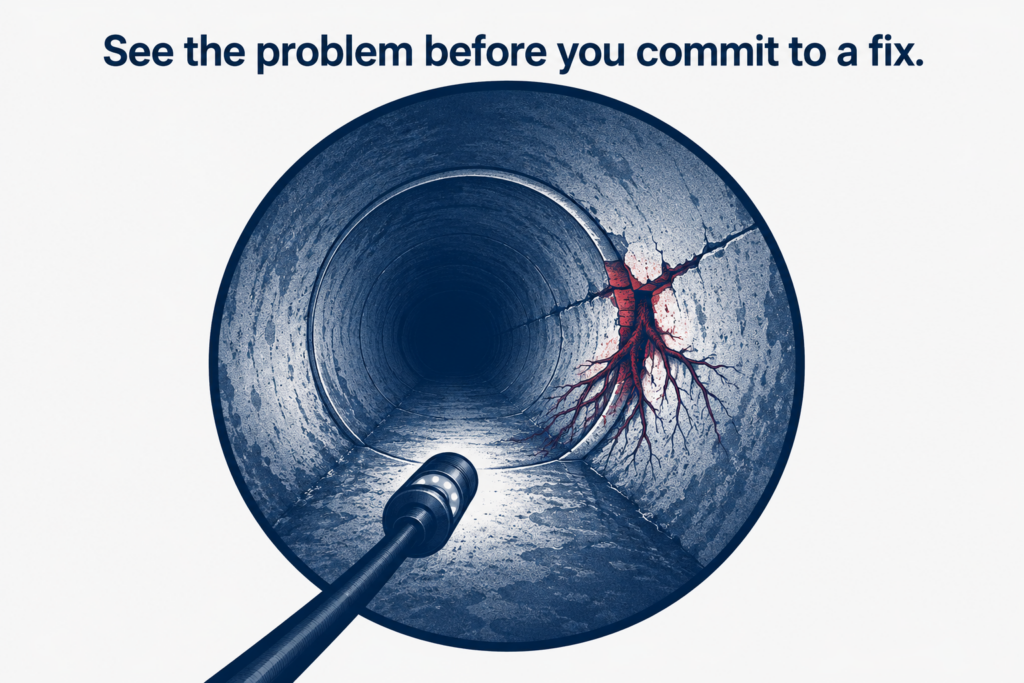
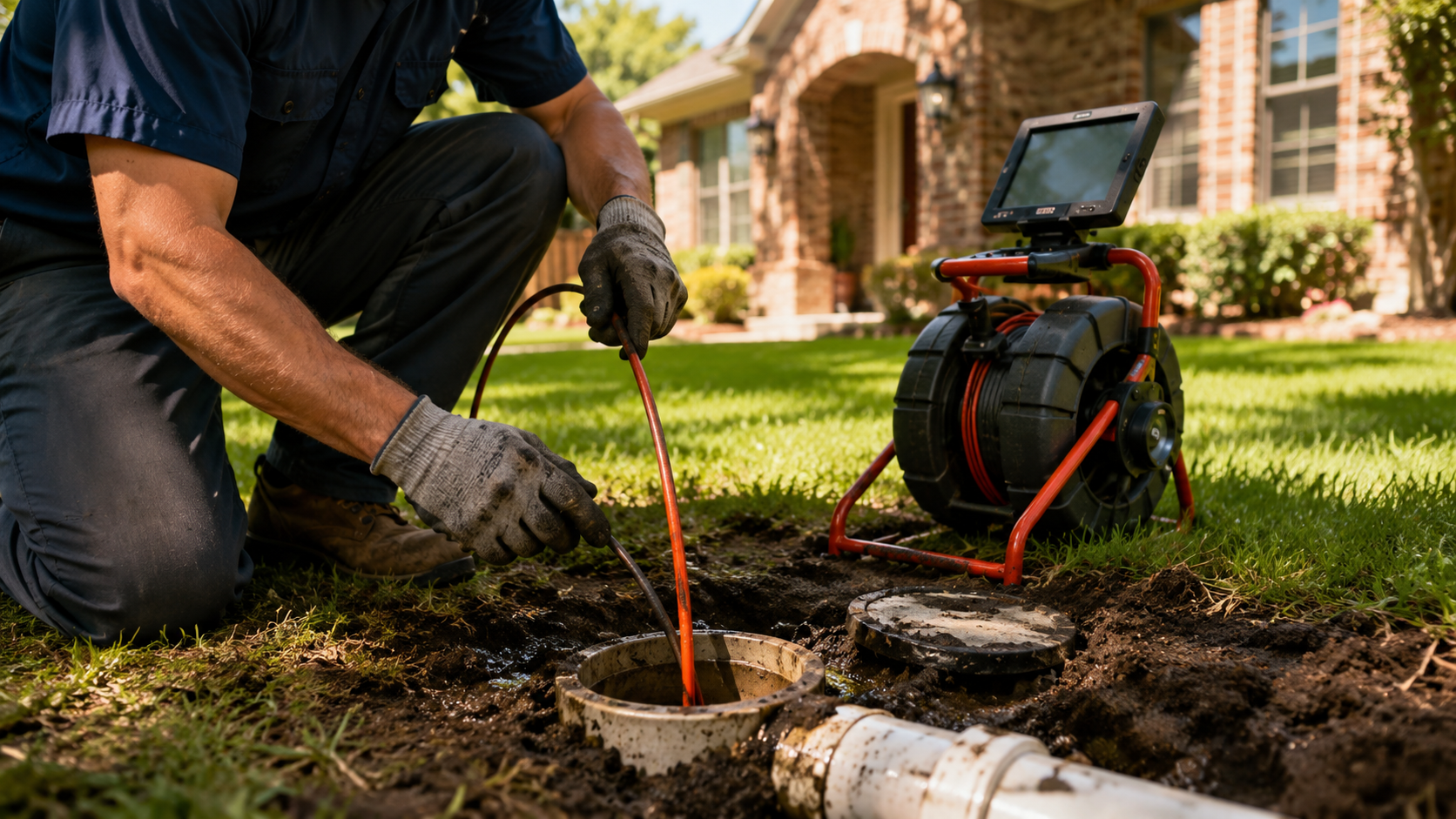
A proper diagnosis comes before a repair quote. The baseline tool is a sewer camera. We run a waterproof camera on a flexible rod through an accessible cleanout and watch a live feed of the inside of the pipe, which shows root intrusion, scale, blockages, separated joints, and collapsed sections. Many camera heads also carry a transmitter, so a technician can trace the signal from above ground and mark the exact spot and depth of the failure. That keeps any digging targeted instead of exploratory. Our in-house sewer line video inspection is how we confirm what is actually wrong before recommending any work. Next to the cost of a major repair, an inspection is a small price for knowing exactly what you are dealing with.

A camera has limits worth knowing. It only sees the inside of the pipe, so a line fully submerged by a belly or a downstream clog has to be cleared before the camera can see anything. It also cannot always catch a hairline crack that leaks into the soil without being visibly displaced. For suspected hidden leaks under a slab, plumbers add a hydrostatic test, which seals the line, fills it with water, and checks whether the level holds steady. If the water level drops, the line is leaking somewhere, and the test can be narrowed down to isolate the failed section. Skipping all of that and quoting a full replacement off symptoms alone is exactly the practice we built our reputation against.

Sewer line repair methods, compared

Once the line is diagnosed, the failure point and the pipe’s overall condition decide the method. These are the main approaches used on Houston homes.

MethodHow it worksBest forDisruption
Spot or point repairAccess and replace a short, localized section of damaged pipe and leave the rest of the line in place.A single cracked joint or one failed segment on an otherwise sound line.Low and localized
Trenchless lining (CIPP)A resin-saturated liner is pulled into the existing pipe and cured in place, forming a new pipe inside the old one.Longitudinal cracks, minor joint gaps, and sealing roots out when the pipe still holds its shape and slope.Minimal, no full trench
Pipe burstingA bursting head is pulled through the old pipe, breaking it outward while drawing new HDPE pipe into the gap.Replacing a full run of deteriorated cast iron or clay pipe along a navigable path.Low, entry and exit pits only
Open-cut excavationMachinery digs a trench from the surface down to the pipe so the failed section can be removed and replaced.Bellied, collapsed, or badly misaligned lines, and open-yard runs where trenchless cannot work.High, trench plus surface restoration
Under-slab tunnelingAn exterior pit is dug, then a hand-dug horizontal tunnel runs beneath the slab to reach and repair the pipe from outside.Failures directly under a slab foundation where the goal is to avoid breaking up interior floors.Moderate outside, none inside the home

Trenchless methods are popular because they spare your landscaping, but they have real limits. A cured liner follows the exact shape of the host pipe, so it will reproduce a belly rather than fix it. And a fully collapsed pipe gives a liner nothing to inflate against and a bursting head no path to follow. When the clay has bellied or flattened a line, excavation is the structurally sound answer.

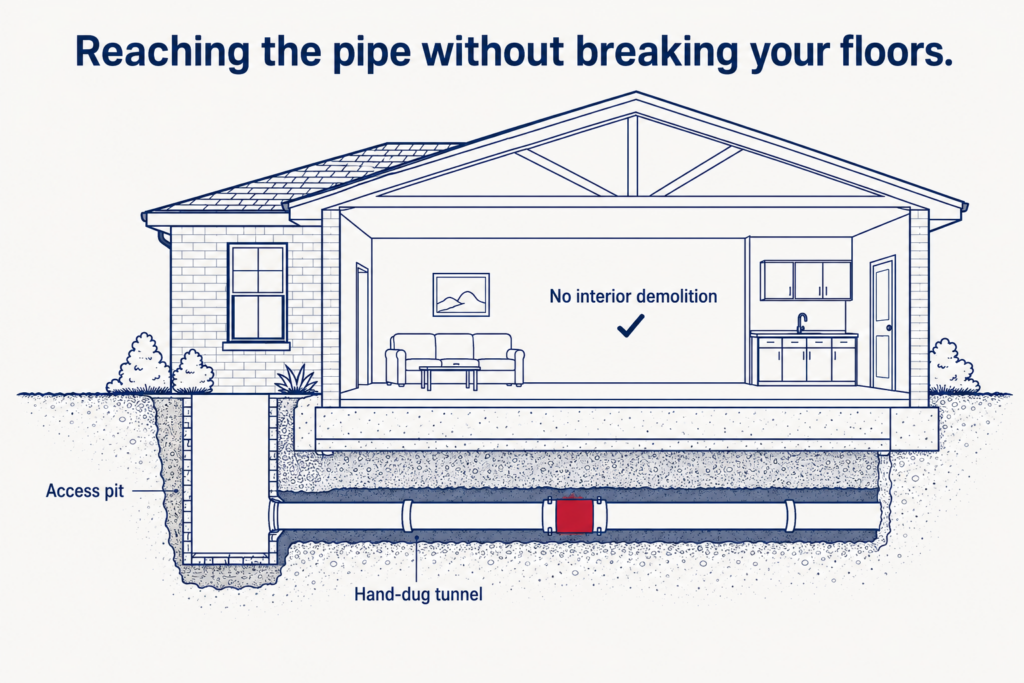
For pipe that runs under the slab, the question becomes how to reach it without jackhammering the floors inside the house. That is where under-slab tunneling comes in. The crew opens an access pit outside the foundation, then hand-digs a horizontal tunnel beneath the slab to the failure, using the underside of the foundation as the tunnel ceiling. The damaged pipe gets removed and replaced from there, and the tunnel is backfilled to code. Harris County infrastructure regulations require excavated voids to be compacted to a high standard density and backfilled with cement-stabilized sand, because a poorly filled tunnel lets the foundation settle later. Done right, tunneling reaches the pipe, protects the slab, and keeps the work outside your living space. It is the method we lean on most for slab-foundation homes, and it is the kind of hands-on work many general plumbers subcontract out.

Repair or replace: which one you actually need

Replacement should be a decision made after the camera inspection, not the opening offer. We get called for second opinions constantly. Another company quotes a full replacement, we run the camera, and the line turns out to need a single failed joint addressed. Sometimes a line genuinely needs replacing. Often it does not. The camera is what tells the difference.

Repair usually makes sense when:

  • The damage is localized to one cracked joint or a short broken segment
  • The rest of the line looks structurally sound on camera
  • The pipe still holds its shape and slope, which makes it a candidate for lining

Replacement is the better long-term call when:

  • An older cast iron line shows widespread corrosion and is failing in more than one place
  • A mature root system has invaded along the length of the line, not just at a single joint
  • The line is collapsed, severely bellied, or back-pitched so wastewater no longer drains by gravity

In those cases, patching one section just buys a few months before the next break, and a full sewer line replacement costs less over time than repeated repairs. The line itself tells you which path it needs, and an honest diagnosis is what separates a targeted sewer line repair from an unnecessary replacement.

What sewer line repair costs in Houston

Cost depends on the method, how deep the pipe sits, how many feet are affected, and what is on the surface above it. Trenching through a soft open lawn is cheap. Cutting through a concrete driveway, mature roots, or hardscaping drives the price up because of the restoration afterward. A localized spot repair costs less than a full replacement, so the diagnosis has a direct effect on the bill.

These are typical Houston ranges for reference, drawn from current market data reported by Angi. The average residential line runs roughly 40 to 60 feet from the house to the curb.

ItemTypical Houston range
Full sewer line replacementAbout $3,000 on average, with most homeowners paying $1,441 to $4,766
Per linear foot, traditional excavation$50 to $300 installed
Per linear foot, trenchless$60 to $250 installed
Sanitary sewer tap permit$30
Excavation permit (right-of-way)$30 to $225

Permits are not optional. The City of Houston requires permits for major sewer work, and a licensed plumber handles the permitting. A contractor who pulls permits is a good sign. A quote that skips them is not.

Who pays, you or the City of Houston?
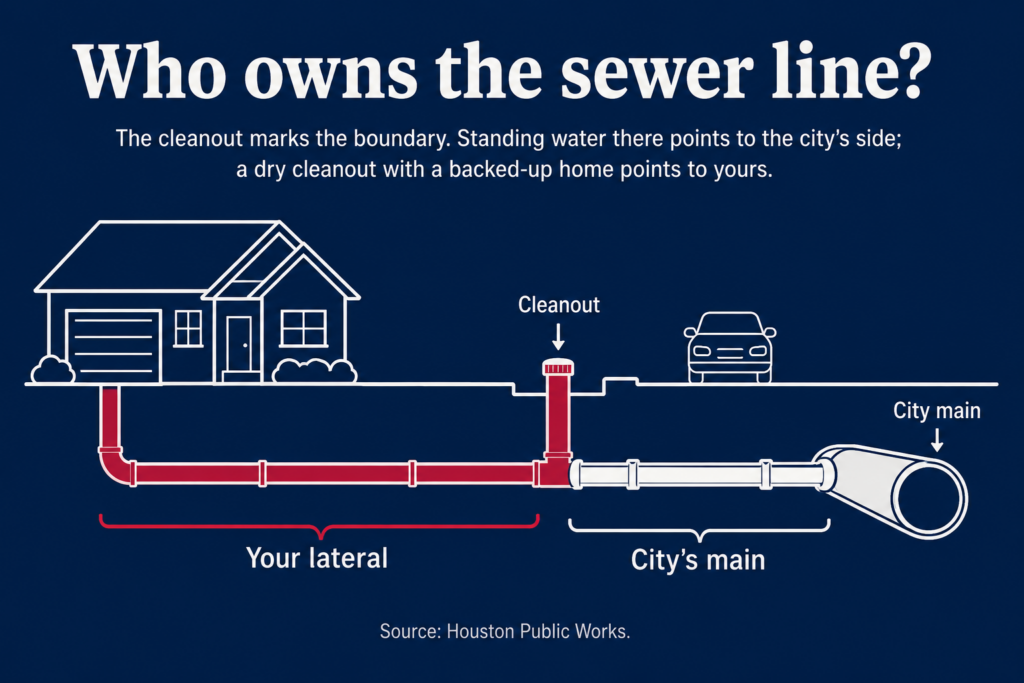
Knowing the answer saves Houston homeowners real money, because you only own part of the system. You are responsible for the sewer lateral, the line running from your home to the city’s main. The city owns the main itself.

The dividing point is the sewer cleanout, a capped white PVC pipe sticking up out of the ground, usually near the property line by the curb. Houston Public Works treats that cleanout as the edge of the city’s system, and there is a simple test you can run during a backup:

  • If sewage is standing or bubbling up around the street-side cleanout, the blockage is downstream in the city main. Do not hire a plumber. Call Houston 311 by dialing 311 or 713-837-0311, and the city dispatches a crew. You can start the request through the Houston 311 system.
  • If the ground around the cleanout is dry while your home is backing up, the problem is on your private lateral, and the repair is yours to arrange.

Private laterals are a bigger source of trouble than most homeowners realize. Tracking by the Bayou City Waterkeeper has found that more of Houston’s recently reported sewer overflows trace back to private sewer lines than to the public mains. Keeping your lateral sound protects your home and the neighborhood around it.

Common questions about sewer line repair in Houston

Can a sewer line be repaired without digging up my whole yard?

Often, yes. Trenchless lining and pipe bursting work through small access points instead of a full trench, and under-slab tunneling reaches pipe beneath the foundation from an exterior pit. A camera inspection determines whether your line is a candidate for one of these.

How long does sewer line repair take?

A localized spot repair is often a same-day or one-day job. Trenchless methods tend to finish faster than open-cut excavation, usually within a few days, while a full dig-and-replace that involves concrete restoration can stretch toward a week. Depth, line length, and what sits above the pipe all move the timeline.

Do I need a permit for sewer line work in Houston?

Yes. Sewer line repair and replacement require a city permit, and a licensed plumber pulls it as part of the job. A contractor who handles the permitting properly is a sign you are dealing with a legitimate company.

Get a diagnosis before you commit to a major repair

If you are seeing slow drains, gurgling toilets, or a sewage smell, or if another company already told you that you need a whole new line, the right next step is a camera inspection, not a signature on a replacement quote. We diagnose the line first, repair what can be repaired, and recommend replacement only when the pipe genuinely warrants it.

As a family-owned, veteran-owned company serving Greater Houston since 1956, with a master plumber on staff and technicians cross-trained across our plumbing services, we handle the under-slab repairs that many Houston homes eventually need. Learn more about our sewer line repair service, or contact us to schedule an inspection.

Sewer line repair fixes a damaged section of the underground pipe that carries wastewater from your home to the city’s sewer main. In Houston, most residential sewer trouble traces back to the same source, expansive clay soil shifting under slab-on-grade foundations and stressing the rigid pipe below. The right repair depends on what a camera inspection finds. A single cracked joint can often be handled with a targeted spot repair, while a collapsed or badly bellied line may need a section replaced or relined. The repair scope should follow the diagnosis.

We have served Houston homeowners since 1956, and at Spring Branch AC we approach sewer work the way we approach HVAC: open the system up, confirm the real problem, and repair what can be repaired before anyone talks about replacement. For the under-slab failures common in Houston’s slab-foundation homes, our crews hand-dig tunnels beneath the slab to reach and repair the damaged pipe from the outside, which keeps the demolition out of your living space. Below, we cover what causes sewer line damage here, how to spot it early, how the repair is actually done, what it costs, and how to tell whether the line is your responsibility or the city’s.

What a sewer line repair actually involves

Your sewer lateral is the privately owned pipe that runs from your home’s plumbing out to the city’s main line. It usually sits under the yard, and in many Houston homes part of it runs beneath the concrete slab. When that pipe cracks, separates at a joint, or sags into a low spot, wastewater either backs up into the house or leaks into the soil underneath.

Repair means fixing or replacing the failed portion of that pipe rather than tearing out the whole line. Depending on the diagnosis, that can mean a localized spot repair, a trenchless reline that creates a new pipe inside the old one, or digging and replacing a damaged section. The first step is always the same: see the actual condition of the pipe before choosing a method. Sewer work sits within our broader sewer and drain services, and every one of those jobs starts with a look inside the line.

Why sewer lines fail in Houston homes

Houston is hard on underground pipe. A few specific local factors do most of the damage.

Shifting clay soil and slab foundations

The Greater Houston area sits on expansive clay, the kind that swells when it absorbs water and shrinks when it dries out. Through a wet Gulf Coast spring and a dry late summer, that soil expands and contracts over and over. Rigid sewer pipe cannot flex with it.

Over the years, that movement pulls pipe joints apart and creates low spots, known in the trade as bellies, where wastewater pools instead of draining. Eventually the pipe wall fractures. In slab-on-grade homes, the same soil movement that cracks a foundation also cracks the drain lines running beneath it. Once a pipe leaks, it saturates the surrounding clay, the clay swells more, and the next failure comes faster.

Tree roots in the line

Mature trees are the second common culprit. Roots chase moisture, and a sewer line full of warm water is a target. A root finds its way in through a small crack or a loose joint, then grows until it slows the flow or breaks the pipe open. One intrusion at a single joint is often a repair. Roots running the full length of an older line are a different situation, which we cover in the repair-versus-replace section below.

Grease, wipes, and everyday clogs

Not every sewer problem is structural. Plenty are blockages. According to Houston Public Works, about 70 percent of the city’s sanitary sewer overflows come from fats, oils, and grease combining with so-called flushable wipes, which do not break down the way toilet paper does. The city’s Protect Our Pipes guidance is blunt: flush only the three P’s, which are pee, poo, and paper, and pour cooled grease into a container for the trash.

A clog and a cracked pipe call for different fixes. Clearing a stoppage with drain cleaning gets the line flowing again, but it does not repair a broken pipe. That is one more reason a camera inspection matters. It tells you whether you are looking at a blockage you can clear or structural damage you need to repair.

Warning signs you may need sewer line repair

Sewer problems usually show themselves before a full backup. Watch for:

  • Several drains running slow at the same time, especially on the lowest floor
  • Gurgling from toilets or drains when you run water somewhere else in the house
  • A sewage smell inside the home or out in the yard
  • Wastewater backing up into tubs, showers, or floor drains
  • Soggy spots, sunken ground, or an unusually green patch of lawn over the line
  • Clogs that keep coming back soon after they are cleared

One or two of these can point to a simple clog. Several at once, or any sewage backup, points to a line problem worth inspecting.

How a sewer line problem gets diagnosed

A proper diagnosis comes before a repair quote. The baseline tool is a sewer camera. We run a waterproof camera on a flexible rod through an accessible cleanout and watch a live feed of the inside of the pipe, which shows root intrusion, scale, blockages, separated joints, and collapsed sections. Many camera heads also carry a transmitter, so a technician can trace the signal from above ground and mark the exact spot and depth of the failure. That keeps any digging targeted instead of exploratory. Our in-house sewer line video inspection is how we confirm what is actually wrong before recommending any work. Next to the cost of a major repair, an inspection is a small price for knowing exactly what you are dealing with.

A camera has limits worth knowing. It only sees the inside of the pipe, so a line fully submerged by a belly or a downstream clog has to be cleared before the camera can see anything. It also cannot always catch a hairline crack that leaks into the soil without being visibly displaced. For suspected hidden leaks under a slab, plumbers add a hydrostatic test, which seals the line, fills it with water, and checks whether the level holds steady. If the water level drops, the line is leaking somewhere, and the test can be narrowed down to isolate the failed section. Skipping all of that and quoting a full replacement off symptoms alone is exactly the practice we built our reputation against.

Sewer line repair methods, compared

Once the line is diagnosed, the failure point and the pipe’s overall condition decide the method. These are the main approaches used on Houston homes.

MethodHow it worksBest forDisruption
Spot or point repairAccess and replace a short, localized section of damaged pipe and leave the rest of the line in place.A single cracked joint or one failed segment on an otherwise sound line.Low and localized
Trenchless lining (CIPP)A resin-saturated liner is pulled into the existing pipe and cured in place, forming a new pipe inside the old one.Longitudinal cracks, minor joint gaps, and sealing roots out when the pipe still holds its shape and slope.Minimal, no full trench
Pipe burstingA bursting head is pulled through the old pipe, breaking it outward while drawing new HDPE pipe into the gap.Replacing a full run of deteriorated cast iron or clay pipe along a navigable path.Low, entry and exit pits only
Open-cut excavationMachinery digs a trench from the surface down to the pipe so the failed section can be removed and replaced.Bellied, collapsed, or badly misaligned lines, and open-yard runs where trenchless cannot work.High, trench plus surface restoration
Under-slab tunnelingAn exterior pit is dug, then a hand-dug horizontal tunnel runs beneath the slab to reach and repair the pipe from outside.Failures directly under a slab foundation where the goal is to avoid breaking up interior floors.Moderate outside, none inside the home

Trenchless methods are popular because they spare your landscaping, but they have real limits. A cured liner follows the exact shape of the host pipe, so it will reproduce a belly rather than fix it. And a fully collapsed pipe gives a liner nothing to inflate against and a bursting head no path to follow. When the clay has bellied or flattened a line, excavation is the structurally sound answer.

For pipe that runs under the slab, the question becomes how to reach it without jackhammering the floors inside the house. That is where under-slab tunneling comes in. The crew opens an access pit outside the foundation, then hand-digs a horizontal tunnel beneath the slab to the failure, using the underside of the foundation as the tunnel ceiling. The damaged pipe gets removed and replaced from there, and the tunnel is backfilled to code. Harris County infrastructure regulations require excavated voids to be compacted to a high standard density and backfilled with cement-stabilized sand, because a poorly filled tunnel lets the foundation settle later. Done right, tunneling reaches the pipe, protects the slab, and keeps the work outside your living space. It is the method we lean on most for slab-foundation homes, and it is the kind of hands-on work many general plumbers subcontract out.

Repair or replace: which one you actually need

Replacement should be a decision made after the camera inspection, not the opening offer. We get called for second opinions constantly. Another company quotes a full replacement, we run the camera, and the line turns out to need a single failed joint addressed. Sometimes a line genuinely needs replacing. Often it does not. The camera is what tells the difference.

Repair usually makes sense when:

  • The damage is localized to one cracked joint or a short broken segment
  • The rest of the line looks structurally sound on camera
  • The pipe still holds its shape and slope, which makes it a candidate for lining

Replacement is the better long-term call when:

  • An older cast iron line shows widespread corrosion and is failing in more than one place
  • A mature root system has invaded along the length of the line, not just at a single joint
  • The line is collapsed, severely bellied, or back-pitched so wastewater no longer drains by gravity

In those cases, patching one section just buys a few months before the next break, and a full sewer line replacement costs less over time than repeated repairs. The line itself tells you which path it needs, and an honest diagnosis is what separates a targeted sewer line repair from an unnecessary replacement.

What sewer line repair costs in Houston

Cost depends on the method, how deep the pipe sits, how many feet are affected, and what is on the surface above it. Trenching through a soft open lawn is cheap. Cutting through a concrete driveway, mature roots, or hardscaping drives the price up because of the restoration afterward. A localized spot repair costs less than a full replacement, so the diagnosis has a direct effect on the bill.

These are typical Houston ranges for reference, drawn from current market data reported by Angi. The average residential line runs roughly 40 to 60 feet from the house to the curb.

ItemTypical Houston range
Full sewer line replacementAbout $3,000 on average, with most homeowners paying $1,441 to $4,766
Per linear foot, traditional excavation$50 to $300 installed
Per linear foot, trenchless$60 to $250 installed
Sanitary sewer tap permit$30
Excavation permit (right-of-way)$30 to $225

Permits are not optional. The City of Houston requires permits for major sewer work, and a licensed plumber handles the permitting. A contractor who pulls permits is a good sign. A quote that skips them is not.

Who pays, you or the City of Houston?

Knowing the answer saves Houston homeowners real money, because you only own part of the system. You are responsible for the sewer lateral, the line running from your home to the city’s main. The city owns the main itself.

The dividing point is the sewer cleanout, a capped white PVC pipe sticking up out of the ground, usually near the property line by the curb. Houston Public Works treats that cleanout as the edge of the city’s system, and there is a simple test you can run during a backup:

  • If sewage is standing or bubbling up around the street-side cleanout, the blockage is downstream in the city main. Do not hire a plumber. Call Houston 311 by dialing 311 or 713-837-0311, and the city dispatches a crew. You can start the request through the Houston 311 system.
  • If the ground around the cleanout is dry while your home is backing up, the problem is on your private lateral, and the repair is yours to arrange.

Private laterals are a bigger source of trouble than most homeowners realize. Tracking by the Bayou City Waterkeeper has found that more of Houston’s recently reported sewer overflows trace back to private sewer lines than to the public mains. Keeping your lateral sound protects your home and the neighborhood around it.

Common questions about sewer line repair in Houston

Can a sewer line be repaired without digging up my whole yard?

Often, yes. Trenchless lining and pipe bursting work through small access points instead of a full trench, and under-slab tunneling reaches pipe beneath the foundation from an exterior pit. A camera inspection determines whether your line is a candidate for one of these.

How long does sewer line repair take?

A localized spot repair is often a same-day or one-day job. Trenchless methods tend to finish faster than open-cut excavation, usually within a few days, while a full dig-and-replace that involves concrete restoration can stretch toward a week. Depth, line length, and what sits above the pipe all move the timeline.

Do I need a permit for sewer line work in Houston?

Yes. Sewer line repair and replacement require a city permit, and a licensed plumber pulls it as part of the job. A contractor who handles the permitting properly is a sign you are dealing with a legitimate company.

Get a diagnosis before you commit to a major repair

If you are seeing slow drains, gurgling toilets, or a sewage smell, or if another company already told you that you need a whole new line, the right next step is a camera inspection, not a signature on a replacement quote. We diagnose the line first, repair what can be repaired, and recommend replacement only when the pipe genuinely warrants it.

As a family-owned, veteran-owned company serving Greater Houston since 1956, with a master plumber on staff and technicians cross-trained across our plumbing services, we handle the under-slab repairs that many Houston homes eventually need. Learn more about our sewer line repair service, or contact us to schedule an inspection.

Previous Post
Next Post

Contact Spring Branch AC

Free estimates available. Licensed, insured, and ready to help.

Scroll to Top