


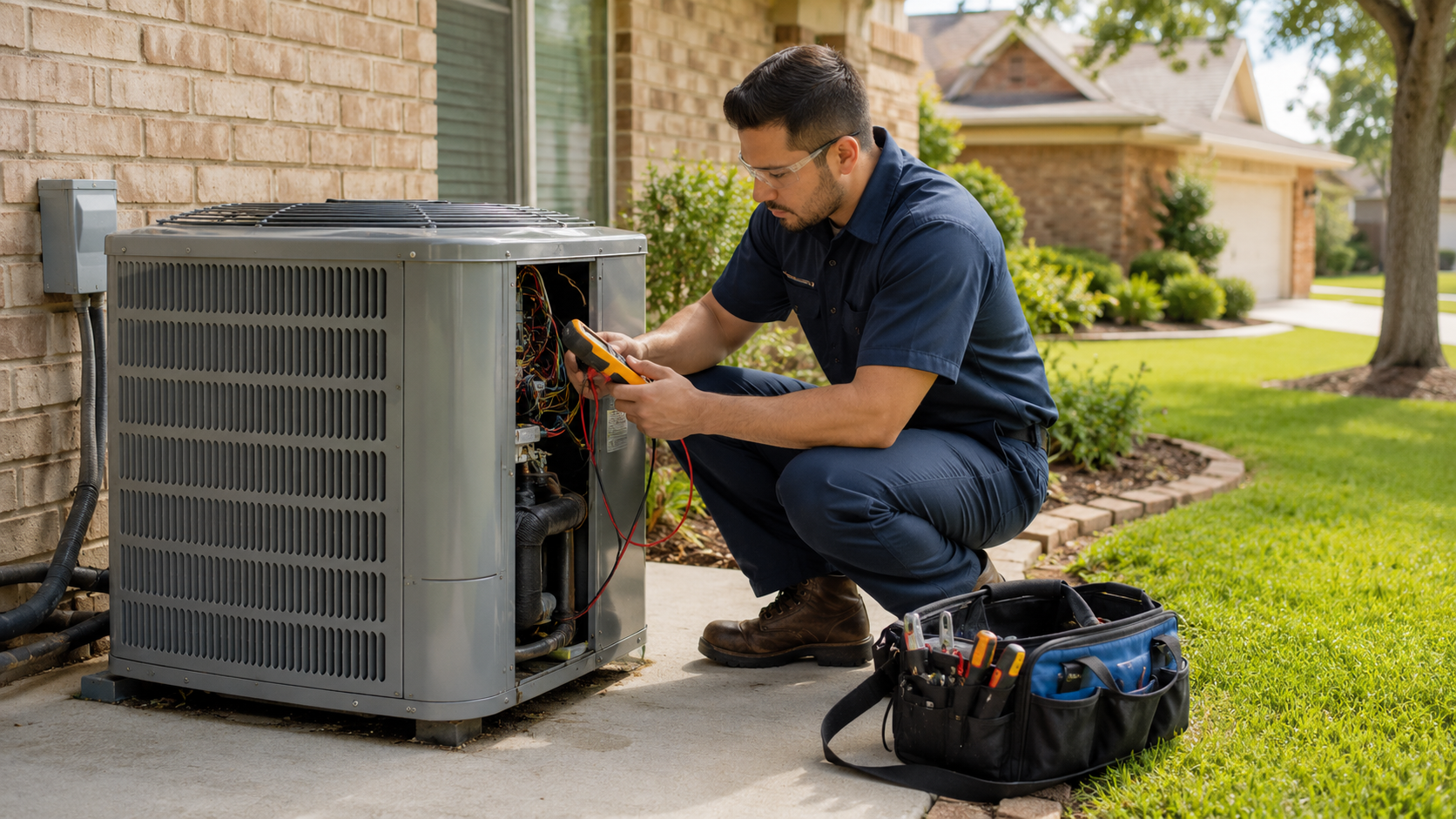
Most air conditioning repairs in Houston cost between $150 and $650, with a typical repair landing around $345. Simple electrical and drain line fixes sit at the low end. Sealed-system work, like a refrigerant leak repair or a compressor replacement, can run well past $1,000. Where your bill falls depends on the failed part, the age of your system, and how hard the equipment is to reach.
At Spring Branch Air Conditioning & Heating, we have repaired Houston AC systems since 1956, and our NATE-certified technicians earn the same pay whether they fix your system or recommend replacing it. That one fact shapes your final bill more than any single part, because the fastest way to turn a small repair into a large one is a diagnosis from someone who is paid to sell equipment. This guide gives you the market ranges first, then shows you how to read them.
What AC repair costs in Houston in 2026
The figures below are market ranges pulled from 2026 cost data published by Angi, HomeGuide, and other national pricing guides. They are fully burdened costs, meaning they include the retail price of the part, the labor to install and calibrate it, and the overhead of dispatching a licensed technician to your home. These are not Spring Branch repair prices. We do not publish flat repair pricing, because the right fix depends on what the technician finds on site.
Repair costs group into three tiers: minor fixes, mechanical repairs, and sealed-system repairs.
| Repair Type | Typical Houston / National Cost Range | Tier |
| Condensate drain line clearing | $75 to $390 | Minor |
| Air filter replacement (by technician) | $20 to $50 | Minor |
| Thermostat repair or replacement | $140 to $650 | Minor |
| Capacitor replacement | $100 to $500 | Minor (electrical) |
| Contactor replacement | $200 to $450 | Minor (electrical) |
| Condenser fan motor | $200 to $950 | Mechanical |
| Blower motor replacement | $300 to $1,200 | Mechanical |
| Refrigerant leak and recharge | $200 to $1,500+ | Sealed system |
| Evaporator coil replacement | $1,000 to $4,500 | Sealed system |
| Condenser coil replacement | $300 to $4,200 | Sealed system |
| Compressor replacement | $600 to $3,200 | Sealed system |
Minor repairs: drain lines, thermostats, and electrical parts
Most service calls in Houston end here, at the affordable end of the range.
- Drain line clearing ($75 to $390): Your AC pulls hundreds of gallons of water out of the air over a season, and that water drains through a PVC line. In our hot attics, that line fills with algae and bacterial growth until it clogs and a safety switch shuts the system off. Clearing it is quick and inexpensive.
- Thermostat replacement ($140 to $650): A basic digital thermostat runs $140 to $350. A Wi-Fi smart thermostat that needs a new C-wire pulled pushes toward $400 to $650.
- Capacitor replacement ($100 to $500): The capacitor is the most common part to fail during a Houston heat wave. The part itself is $15 to $80, but the burdened cost reflects the labor to safely discharge a high-voltage component and wire it correctly.
- Contactor replacement ($200 to $450): This heavy-duty electrical relay closes every time your system starts. Years of arcing burn and pit the contacts until it fails.
Mechanical repairs: fan and blower motors
- Condenser fan motor ($200 to $950): An older PSC motor replaces for $200 to $680. A high-efficiency variable-speed ECM motor runs $650 to $950.
- Blower motor ($300 to $1,200): The indoor motor that moves air across your coil. Proprietary ECM blower modules land at the top of the range, especially with the difficult attic access common in Houston homes.
Sealed-system repairs: refrigerant, coils, and compressors
These are the repairs that drive the repair-versus-replace decision, covered in its own section below.
- Refrigerant leak and recharge ($200 to $1,500+): A sealed AC system does not use up refrigerant, so low refrigerant always means a physical leak. A proper repair finds the leak, welds it shut, evacuates the lines, and weighs in fresh refrigerant.
- Evaporator or condenser coil ($300 to $4,500): Under warranty you pay only labor and refrigerant, roughly $1,000 to $2,500. Out of warranty, an evaporator coil can reach $4,500.
- Compressor ($600 to $3,200): The mechanical heart of the outdoor unit. A compressor cannot be opened and fixed in the field, so a failed one is replaced as a whole component.
Why AC repairs cost more in Houston than the national average
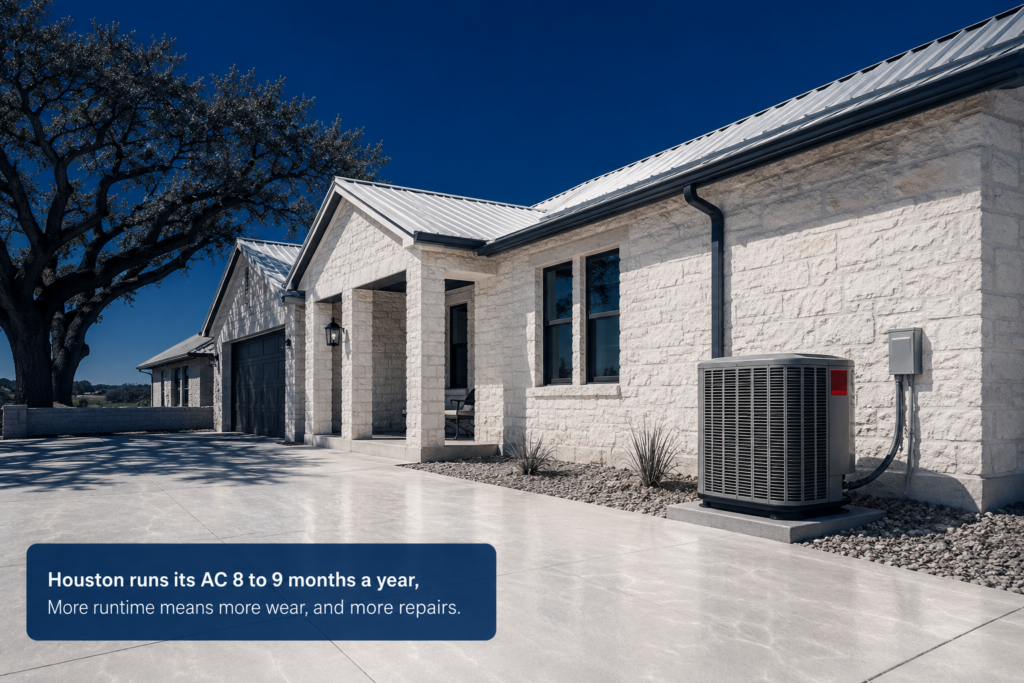
Houston sits in what the U.S. Department of Energy classifies as Climate Zone 2A, a hot-humid region. That classification explains most of the price gap.
- Near-constant runtime. Our cooling season stretches from late March into November. Systems run hard for eight or nine months a year, so parts like capacitors, contactors, and motors wear out faster and fail more often than they do up north.
- Attic access. With high water tables and few basements, most Houston air handlers and coils live in the attic. In July, that attic can hit 130 to 150 degrees. Working safely in that heat takes longer and adds a difficult-access premium of roughly $25 to $100 to many visits.
- Refrigerant prices. More on this below, but the phase-down of older refrigerants has pushed recharge costs sharply higher in 2026.
- Peak-season emergency premiums. Most breakdowns happen in July and August, exactly when technicians are booked solid.
The R-410A refrigerant price surge
If your repair involves refrigerant, timing matters. Under the EPA’s phase-down of high-global-warming refrigerants, manufacturers stopped building new residential systems charged with R-410A as of January 2025. Anticipating scarcity, wholesalers raised prices well ahead of demand.
For a Houston homeowner in 2026, an R-410A recharge now runs about $40 to $90 per pound installed. A typical 3-ton system holds 6 to 12 pounds, so a full recharge with leak detection and labor commonly totals $500 to well over $1,000. Older systems that still use R-22 are worse, at roughly $90 to $150 per pound, since R-22 is no longer produced and comes only from reclaimed stock. A major leak on an R-22 system often costs more in refrigerant alone than the system is worth keeping.
Nights and weekends: what the emergency premium usually adds
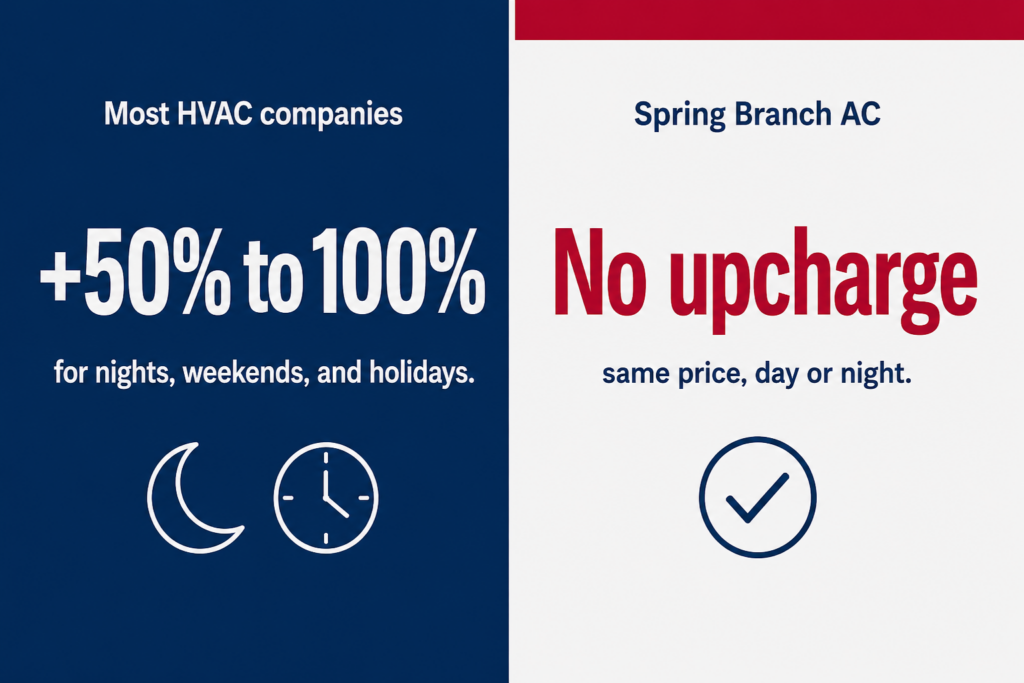
Across Texas, after-hours and weekend service typically carries a premium of 50 to 100 percent over standard rates. An after-hours diagnostic fee can jump to $200 to $400, and emergency labor can reach $150 to $250 an hour or more. Since most AC failures happen during a summer weekend, that premium hits a lot of households.
We answer our phones 24/7 and do not add a charge for nights, weekends, or after-hours calls. When your system quits at 9 p.m. on a Saturday in August, that policy is why your bill looks the same as it would on a weekday afternoon.
The most expensive thing on a repair bill is a wrong diagnosis
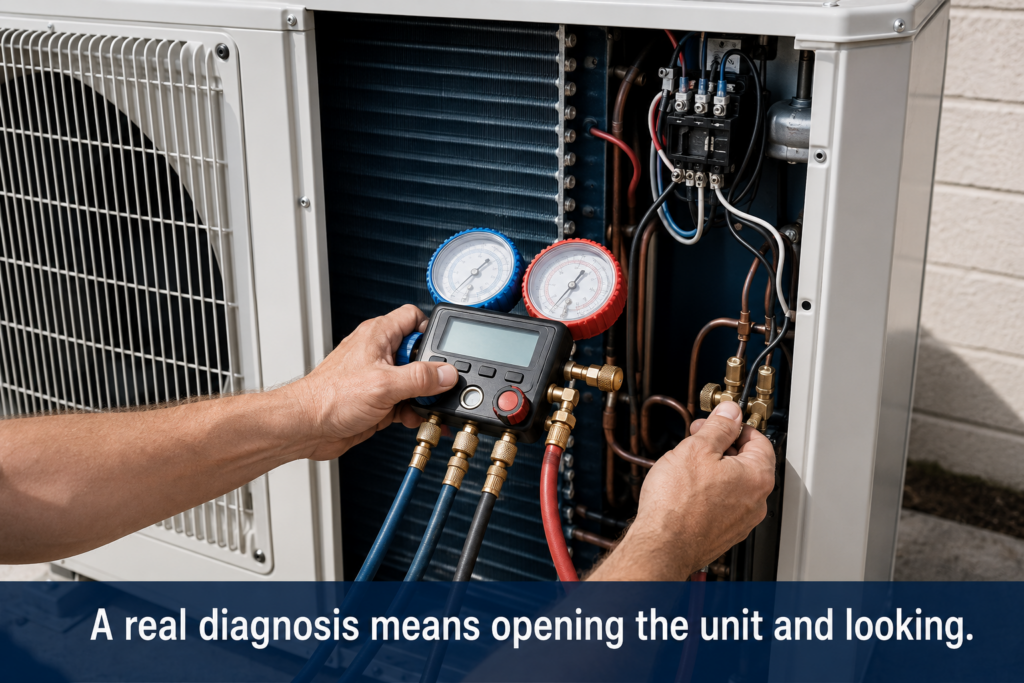
The single biggest swing in what you pay is whether the person looking at your system is trying to fix it or sell you a new one.
We were called for a second opinion on a home that was on the market. Another company had told the seller that biological growth had spread through the system and the ductwork, and that the whole system needed to be replaced. Chris opened the unit up and looked. The blower assembly was clean. The evaporator coil was clean. The plenum and ductwork were clean. What the first company had pointed to was surface growth on the outside casing, the kind of condensation residue you get on a zoned system in a hot attic. The inside was in good shape. The system did not need to be replaced. It needed a few minor items addressed, and that was it.
The lesson holds for any repair. A lazy or dishonest look at your system, the kind that skips opening the unit and jumps straight to a replacement quote, is the most expensive outcome you can get. A capacitor problem gets sold as a new system. Surface residue gets sold as a full teardown. Because our technicians are not on commission, the recommendation you get is the one the equipment actually calls for. You can read more about how we weigh that call on our repair or replace guide.
How maintenance keeps repair costs down
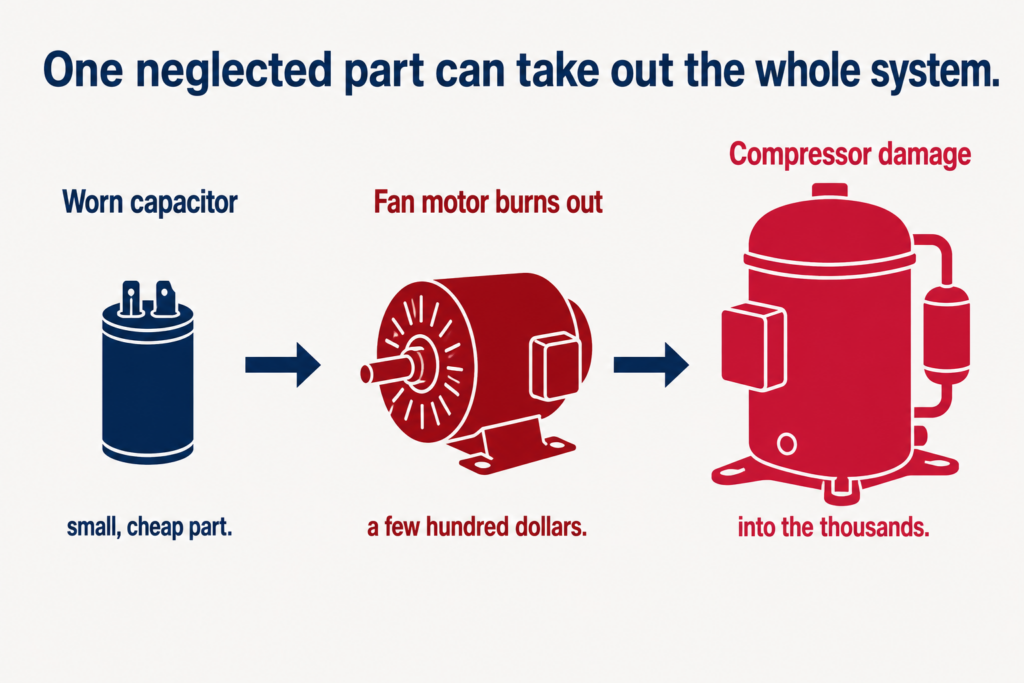
AC systems fail in a chain. One small, cheap fault, left alone, takes out a big expensive part. The most common version in Houston runs through the capacitor.
A capacitor is roughly a $75 part. As it weakens, it stops delivering the full jolt the fan motor and compressor need to start. The motors then strain to start, drawing heavy current and running hot, and that heat eventually breaks down the windings. What started as a $75 capacitor turns into a roughly $375 repair once it takes out the fan motor, or worse, a compressor in the thousands. We have seen the same chain start with a $20 air filter that no one changed, which starves the system, freezes the coil, and sends liquid refrigerant back into a compressor built only to handle gas.
A tune-up catches the weak capacitor before it takes anything else down. Our maintenance agreement is $149 a year and includes two visits, one in spring for the AC and one in fall for the heater, plus priority scheduling and member savings on any repairs you do need. Cleaning the coils alone protects real money, because a dirty coil forces the system to work harder and burn more electricity to move the same amount of heat.
When repair costs mean it is time to look at replacement
Every system reaches a point where continuing to repair it costs more than it returns. A central AC in the Houston climate usually lasts 10 to 15 years. When a major failure hits late in that window, the real question is whether your money is better spent fixing the old system or put toward a new one. Two rules of thumb make the call easier.
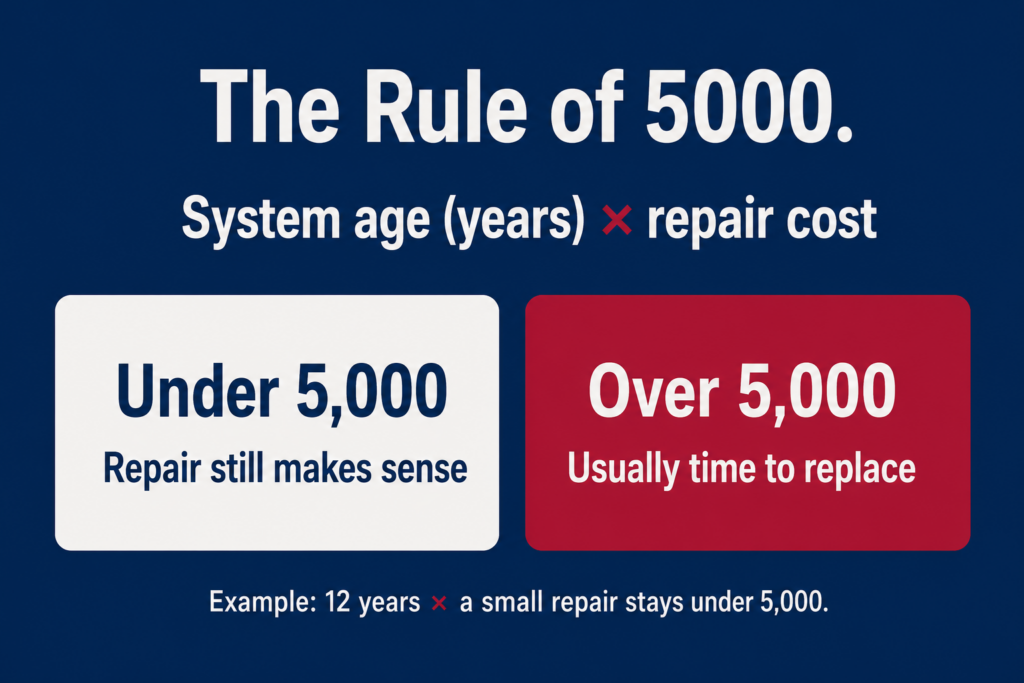
The Rule of 5000. Multiply the age of the system by the cost of the repair. If the result is over 5,000, replacement is usually the sounder financial move. If it is under 5,000, repair still makes sense.
- A 12-year-old system needing a $250 capacitor: 12 x 250 = 3,000. Well under 5,000, so fix it and get more years out of it.
- An 8-year-old system needing an $800 blower motor: 8 x 800 = 6,400. Over 5,000, so that money is better applied toward a new system.
- A 14-year-old R-22 system needing a $1,400 leak repair: 14 x 1,400 = 19,600. Far past the threshold, and it still uses a refrigerant that is no longer produced.
The 50 percent rule. If a repair costs half or more of what a comparable new system would cost, replacement usually wins. Age brackets sharpen this. Under 10 years, most major parts are still under warranty, so repair. From 10 to 15 years, repair only if the fix is minor. In the past 15 years, replacement is almost always the better use of your money.
For context, a full system replacement in Houston in 2026 typically runs as follows by home size:
| Home Size | Required Tonnage | Estimated Houston Replacement Cost |
| 1,200 sq. ft. | 1.5 to 2.0 tons | $4,500 to $7,000 |
| 1,500 sq. ft. | 2.0 to 3.0 tons | $5,000 to $8,500 |
| 1,900 sq. ft. (median) | 2.5 to 3.5 tons | $5,300 to $9,000 |
| 2,200 sq. ft. | 4.0 to 4.5 tons | $7,000 to $12,500 |
| 2,500 sq. ft. | 4.5 to 5.0 tons | $7,700 to $13,500 |
| 3,000+ sq. ft. | 5.0+ tons | $8,300 to $16,000+ |
When the math points to replacement, we lay out the numbers plainly rather than pressure you into a decision, and financing is available for the larger jobs so the timing works for your household.
Diagnostic fee vs. free estimate: know the difference
One of the easiest ways to get overcharged is to confuse a paid diagnostic with a free sales estimate.
A diagnostic is real technical work. A licensed technician spends 45 to 90 minutes with meters and gauges, testing voltage, measuring capacitance, and checking refrigerant pressures to find the actual cause. Because it consumes skilled labor, most reputable companies charge a diagnostic or service call fee, often $75 to $200 in most markets and higher in a spread-out metro like Houston. Many will credit that fee toward the repair if you approve the work.
A free estimate is a sales visit. It is the right tool when you already know you need a new system and want quotes. The problem is that some companies advertise a free repair estimate to get a salesperson in your door, do a quick surface look, and push straight to a replacement quote. Before you book, ask any company two questions: is there a service call fee, and does it apply toward the repair if I approve it? A company that answers clearly is one you can trust with the rest of the bill.
Frequently asked questions about AC repair cost in Houston
How much does it cost to replace an AC capacitor in Houston?
A capacitor replacement typically costs $100 to $500 fully installed. The part is only $15 to $80, but the price reflects the labor and safety involved in handling a high-voltage component.
Why does AC repair cost more in the summer?
Most companies charge 50 to 100 percent more for after-hours and weekend calls, and summer is when systems fail and technicians are busiest. We do not add nights, weekend, or after-hours charges, so your repair costs the same in an August heat wave as it would in April.
How much does an AC refrigerant recharge cost in 2026?
For R-410A, expect about $40 to $90 per pound installed, or $500 to over $1,000 for a full recharge with leak repair on a typical 3-ton system. Older R-22 systems cost $90 to $150 per pound. A recharge only lasts if the underlying leak is fixed.
Is it cheaper to repair or replace my AC?
Use the Rule of 5000: multiply the system’s age by the repair cost. Under 5,000, repair. Over 5,000, replacement usually makes more financial sense, especially on systems over 10 years old.
Does a small AC problem really lead to a big repair?
Yes. A weak capacitor can burn out a fan motor or compressor, and a clogged filter can freeze the coil and damage the compressor. A twice-yearly tune-up catches these before the cheap part takes out the expensive one.
Get an honest AC repair quote in Houston
If your AC is down or not keeping up, we will send a real technician to diagnose it, tell you exactly what it needs, and give you a straight answer on whether to repair or replace. No commissions and no upcharge for nights or weekends. Contact Spring Branch Air Conditioning & Heating or call us any time, and see our current special offers before you book. You can also learn more about our AC and HVAC repair service in Houston.