


By Chris Crawford, Owner of Spring Branch AC
If you’re trying to find a water leak in your Houston home, start with your water meter. Turn off all the water in the house, then see whether the numbers on the meter change over the next two hours. If they do, water is leaking somewhere. Most of the leaks we find turn out to be in a toilet tank.
At Spring Branch AC we work on both plumbing and air conditioning, so we track down leaks from pipes and leaks from AC drains. These are the checks I’d have you run, in this order, before you pay anybody to come out:
- The water meter, to confirm the leak
- The main shutoff valve, to tell inside from outside
- Toilets, faucets and appliance lines
- Slab leak signs
- The AC drain line
If you’ve got a stain on the ceiling or water dripping from a pipe outside near the roofline, start with the AC instead. Your air conditioner pulls water out of the air as it cools. The meter only counts water coming in from the street, so a leak from the AC never shows up on it.
What are the signs of a hidden water leak?
A water bill that’s higher than it should be is one sign of a hidden leak. Others you can hear, see or feel:
- Running water you can hear when everything is off
- A toilet that refills by itself when nobody has used it
- A damp spot or a stain on a wall or ceiling
- A warm spot on a tile or concrete floor
- A patch of yard that stays soggy when it hasn’t rained
A high bill alone doesn’t prove a leak, because meters and billing can be wrong too.
How to find a water leak in Houston with your water meter
- Find the meter. It’s usually in a box in the ground near the street, under a lid.
- Turn off all the water, inside and out. Don’t forget the ice maker, the sprinkler system and the water softener. Any of those can move the meter and look like a leak. Ask everybody in the house not to flush or run anything.
- Look for the leak indicator. Many meters have a small triangle or dial that spins whenever water is flowing. If it’s turning with everything off, you have a leak. If your meter doesn’t have one, use the numbers instead.
- Write down the numbers and wait two hours without using any water. A slow leak barely moves the numbers, so don’t cut the wait short.
- Read the meter again. If the numbers changed, you most likely have a hidden leak.
Is the leak inside or outside the house?
Close the main shutoff valve for the house and check the meter again. That tells you whether the leak is in the house or outside it.
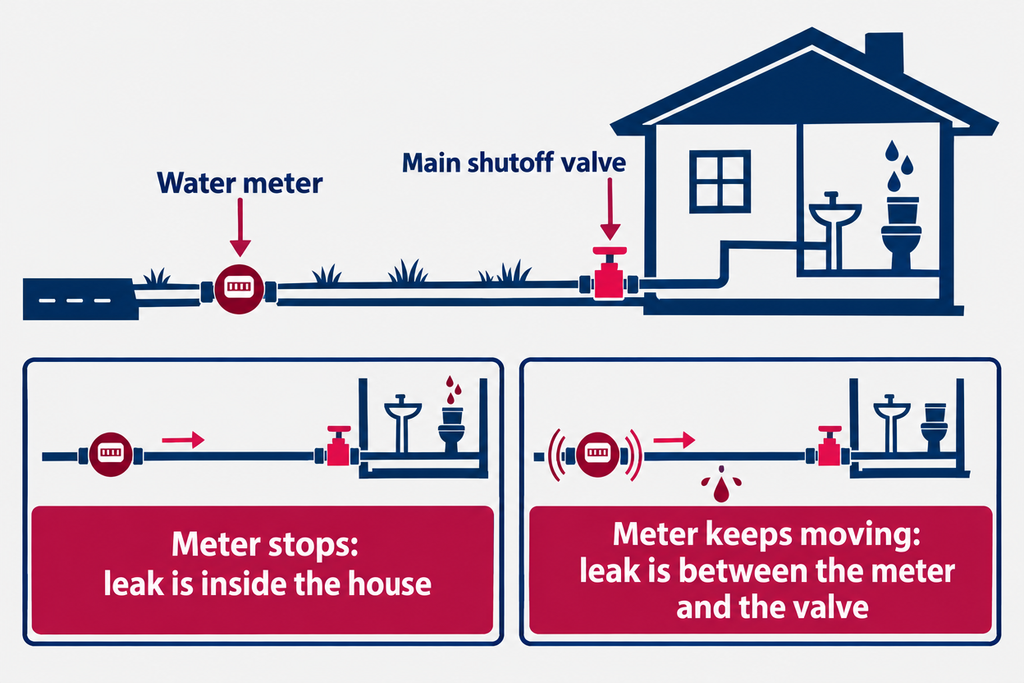
- If the meter stops, the leak is inside the house. Start with the toilets.
- If it keeps moving, the leak is between the meter and the valve: the line under the yard, or an outdoor line like the sprinklers.
Outside, check for a soggy patch of yard and for drips at the outdoor faucets and sprinkler heads.
If you’re not sure where the main shutoff valve is, see “What should I do if I find a major water leak?” If you still can’t find the valve, skip closing it and go straight to the toilets.
How do I test my toilet for a leak?
A toilet is leaking if food coloring you put in the tank shows up in the bowl without a flush. Toilet leaks are easy to miss because they’re usually silent. A leaky toilet can waste 200 gallons of water a day.
Flush valve dye test
- Take the lid off the tank and flush.
- After the tank refills, add several drops of dark food coloring or a leak detector tablet to the tank, not the bowl.
- Wait at least 20 minutes without flushing.
- If any color shows up in the bowl, there’s a leak.
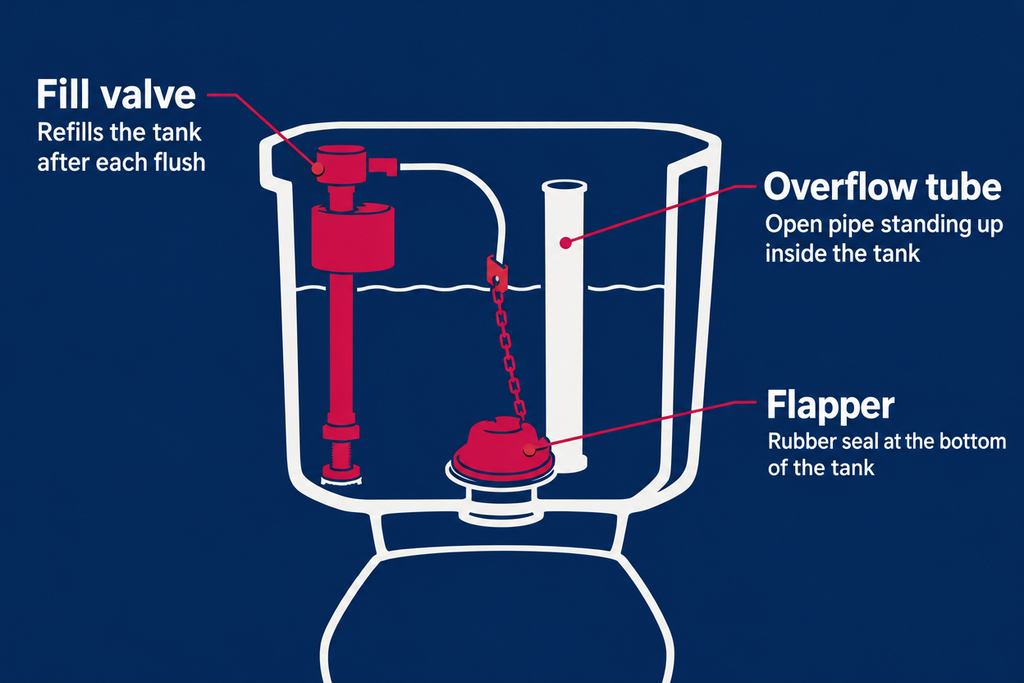
Color in the bowl usually means a worn flapper, the rubber seal at the bottom of the tank. Plenty of homeowners replace one themselves.
Fill valve test
The fill valve is the part that refills the tank after each flush.
- Take the lid off the tank and let it fill.
- Once it’s full, watch the overflow tube, the open pipe standing up inside the tank.
- If water keeps running into that tube, the fill valve may be set to fill the tank too high, or it may not be closing all the way. Either way, it needs adjusting or replacing.
If you’d rather hand it off, flapper replacement and fill valve work are some of the most common toilet repairs we do.
How do I check faucets and appliances for leaks?
Once the toilets check out, look for drips at everything else that uses water: under each sink, around the water heater, and behind the washing machine and refrigerator, where the water lines connect. Then run each faucet for a minute and look under the sink again. A leaking drain pipe only drips while water is going down it. That water is on its way out of the house, not coming in, so the meter test can’t catch it. If you find one, our drain line repair page covers what fixing it involves.
How do I know if I have a slab leak?
A slab leak is a leak in a water pipe that runs under the concrete slab your house sits on. You’re probably looking at one if the meter shows a leak but the toilets, fixtures and yard all check out, and you notice any of these:
- Running water you can hear with everything turned off
- A warm spot on the floor, which typically lines up with the path of a leaking hot water pipe
- Cracks low on interior walls or along the baseboards, or carpet that’s damp from underneath
A lot of Houston homes sit on gumbo clay, which swells when it’s wet and shrinks when it dries out. Over the years, that back-and-forth movement can crack a pipe under the slab.
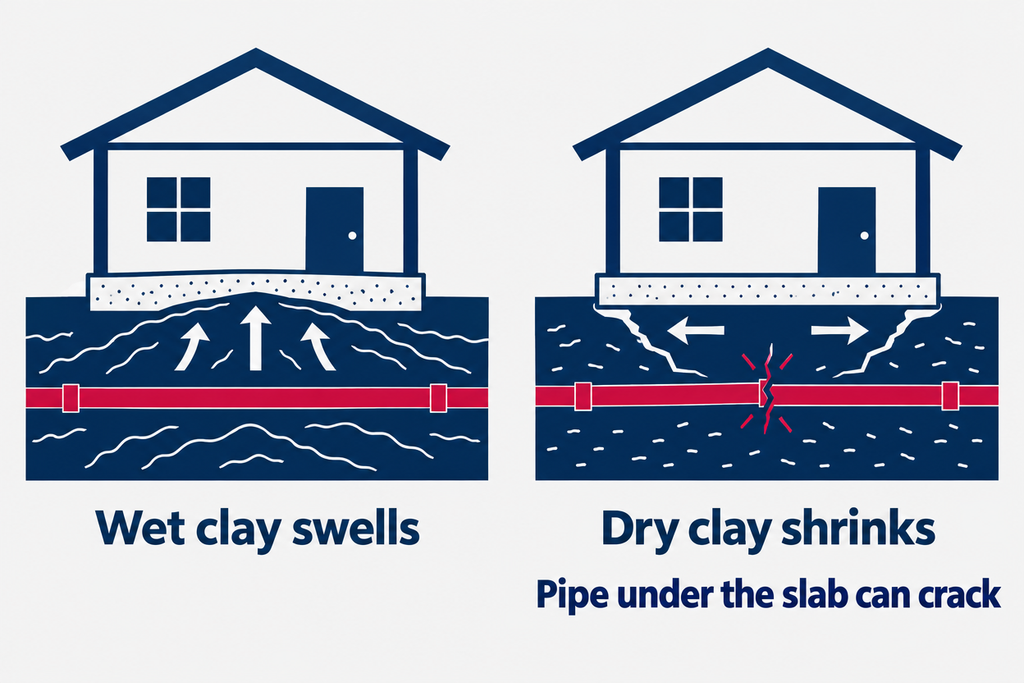
You can suspect a slab leak, but finding and confirming one takes a plumber with leak locating equipment.
Could the leak be coming from my AC?
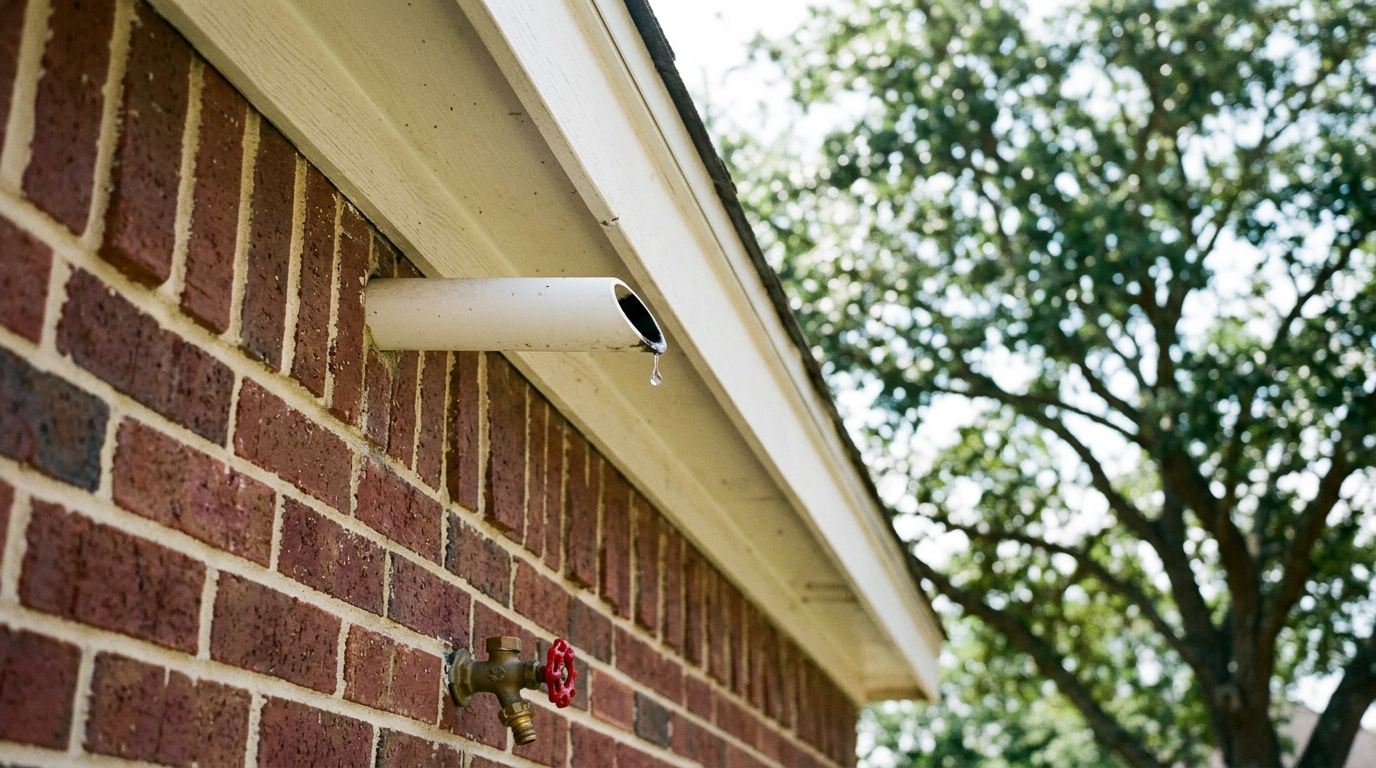
The quickest way to tell is outside. Walk around the house and look up near the eaves for a small pipe sticking out of the wall. That’s the AC’s emergency drain line (here’s my video on it). If water is dripping from it, your AC’s main drain is clogged, and that’s bad juju.
Definitely check every side, because the emergency drain line almost always ends up on the side of the house where nobody’s at. God forbid they put it by the kitchen window, where somebody might actually see it. My own emergency drain line was dripping, and I hadn’t noticed. I happened to see it while goofing with the water hose at my house, so I got to go up in my own attic and clear my own drain line. The painter’s house never gets painted. You can see the drip in the video I made at my house.
When the AC’s drain clogs, the water backs up in this order:
- The AC’s main drain line usually runs to a bathroom sink, which most people have no clue about. Under the sink, it connects to the household drain. Over time, algae builds up at that spot and clogs it. That’s the most common reason AC drains back up.
- The water backs up into the emergency drain pan, a shallow pan under the AC unit in the attic.
- The pan empties through the emergency drain line, the pipe by the eaves. That’s the drip you see outside.
- If the emergency drain line is clogged too, the pan overflows and the water comes through your ceiling.
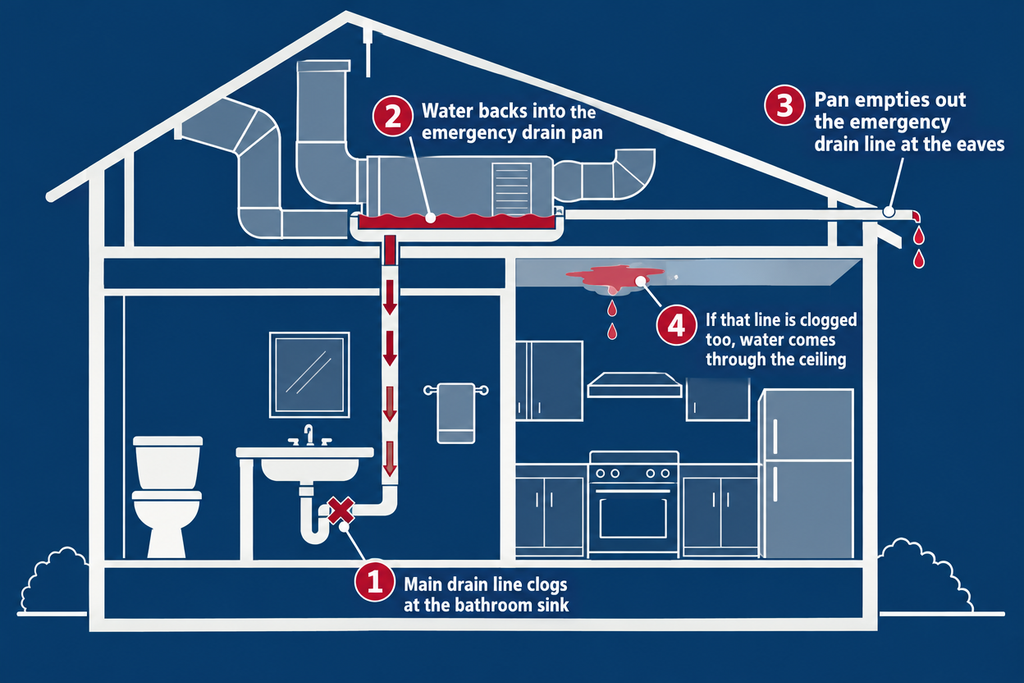
I’ve been in an attic where the emergency drain line and the bathroom sink were both stopped up, and the water ended up all over the kitchen ceiling. The stain won’t always show up right under the unit, either, because water can travel along the framing before it comes through.
A float switch in the emergency pan shuts the AC off when water collects there, so the pan doesn’t overflow. That kitchen job didn’t have one. If your AC shuts off on a hot day and won’t stay on, a full drain pan is one possible reason.
What should I do if I find a major water leak?
Stop the water first, then make your calls.
- Close the main shutoff valve. Many houses have one in the garage. If you can’t find it or can’t get it closed, shut the water off at the meter, out by the road. Turn its valve clockwise (righty tighty, lefty loosey) until the water stops. I show both valves in my Winter Weather video.
- Call a plumber.
- Call your insurance company if the water has damaged anything.
- Don’t touch wet electrical fittings like outlets, switches or light fixtures. Call an electrician instead.
If only a sprinkler line broke, you can close just the sprinkler valve and keep water in the house. The sprinkler valve is usually between the meter and the house.
If the water is coming from your AC, the main valve won’t stop it. Turn the AC off at the thermostat, then have a technician clear the drain line.
When should I call a professional about a water leak?
It’s time to stop checking and call a professional when:
- The meter shows a leak and you can’t find it
- You notice any of the slab leak signs
- Water is coming from the AC. Calling when you first see the drip keeps it off your ceiling.
For an early warning on the next leak, we install leak detectors that sound an alarm or alert your phone when they sense a leak. They can also shut off the water to the house on their own.
If the leak is coming from your AC, we’ll come over, take your sink apart and vacuum out the AC drain line for you. For a toilet or a leak you can’t find, our plumbing services page has the details on what we do. Give us a shout at (713) 937-6739. Our phones are answered 24/7.