

How to Choose the Right HVAC Contractor in Houston, TX (2026)

How to Choose the Right HVAC Contractor in Houston, TX (2026)

How to Choose the Right HVAC Contractor in Houston, TX (2026)

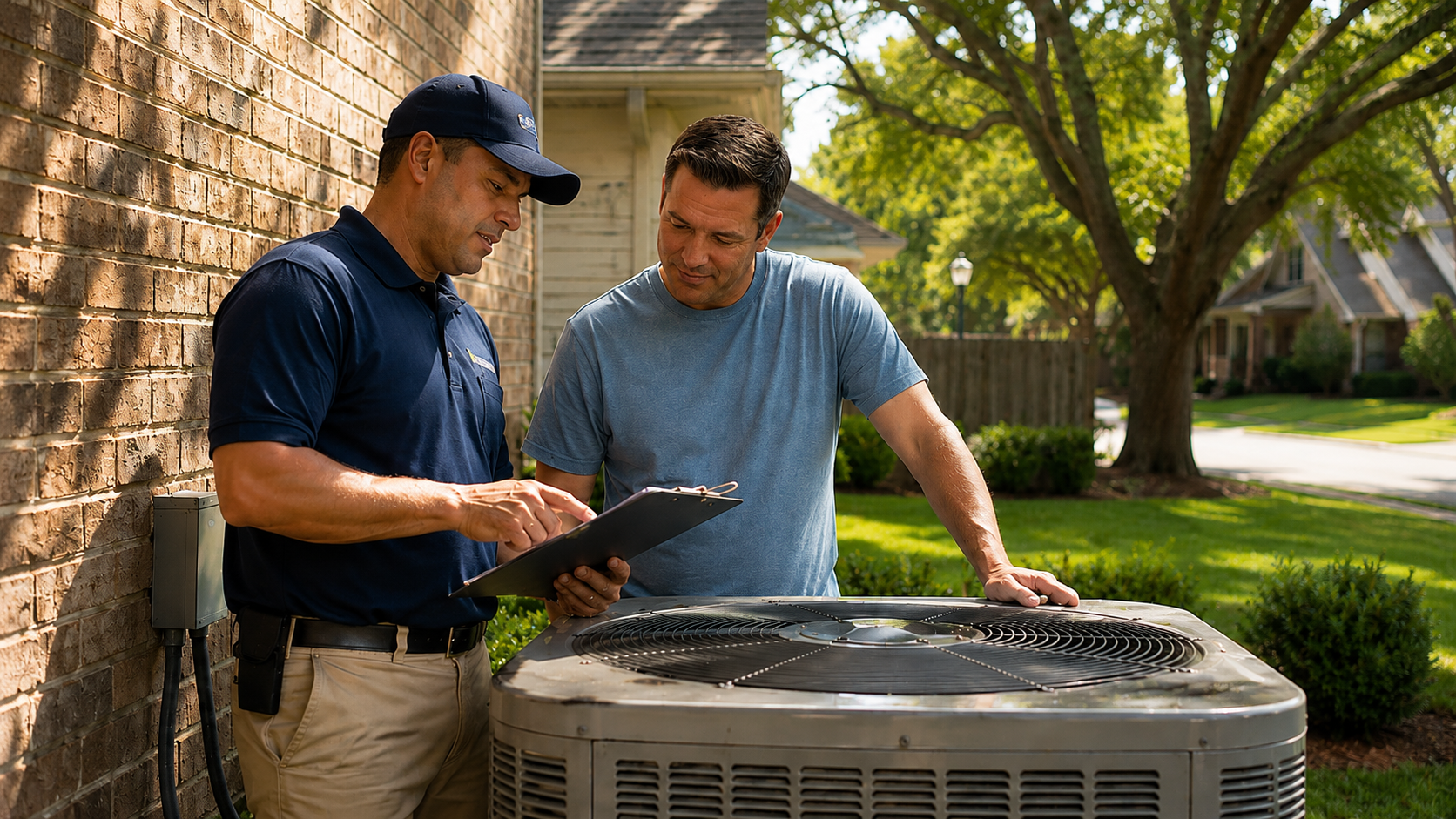
A Spring Branch AC technician in uniform inspects an outdoor residential air conditioning condenser at a Houston home, representing a licensed HVAC contractor who diagnoses equipment before recommending repairs or replacement. The image supports the blog’s guidance on choosing a trustworthy HVAC company by verifying licensing, technician certifications, insurance, written estimates, load calculations, permits, and repair-first service instead of high-pressure sales tactics.

The most reliable way to choose an HVAC contractor in Houston is to verify a short list of things any homeowner can confirm on their own: an active Texas license, the right technician certifications, proof of insurance, a real load calculation before any new equipment, and a clear written estimate you can compare against others. Get those right, and one question answers itself. Are you hiring a technician or a salesperson?

At Spring Branch AC, we’ve serviced Houston-area homes since 1956 under Texas license TACLB49330E, a number you can look up yourself in about a minute. We run a repair-first shop with no commissioned salespeople, which shapes how we think about this entire decision. The criteria below are the same ones we’d want our own family to use, whether they hire us or someone else.

The real question: are you hiring a technician or a salesperson?

A licensed company can still send a salesperson to your door. The difference shows up in behavior. A technician diagnoses the actual problem, opens the equipment to look before condemning anything, and recommends the least expensive fix that solves it. A sales-driven operation arrives looking for a reason to sell you a new system.

Every criterion that follows maps to something you can verify with a phone, a website, and a willingness to ask. An honest contractor welcomes those questions. A salesperson gets cagey. The same split runs through every point below.

Verify the Texas HVAC contractor license first

This is the non-negotiable first step. In Texas, residential HVAC companies must hold an active Air Conditioning and Refrigeration (ACR) Contractor License issued by the Texas Department of Licensing and Regulation (TDLR). The license is held at the company level, and it is the single most verifiable thing about any contractor you’re considering.

Texas issues two classes. Class A covers units of any size. Class B covers cooling systems up to 25 tons and heating up to 1.5 million BTU per hour, which covers virtually all residential work. License numbers read as TACLA (Class A) or TACLB (Class B) followed by digits. Ours, TACLB49330E, is a Class B license with the environmental air conditioning endorsement that covers home comfort systems.

How to check an HVAC contractor’s license in Texas
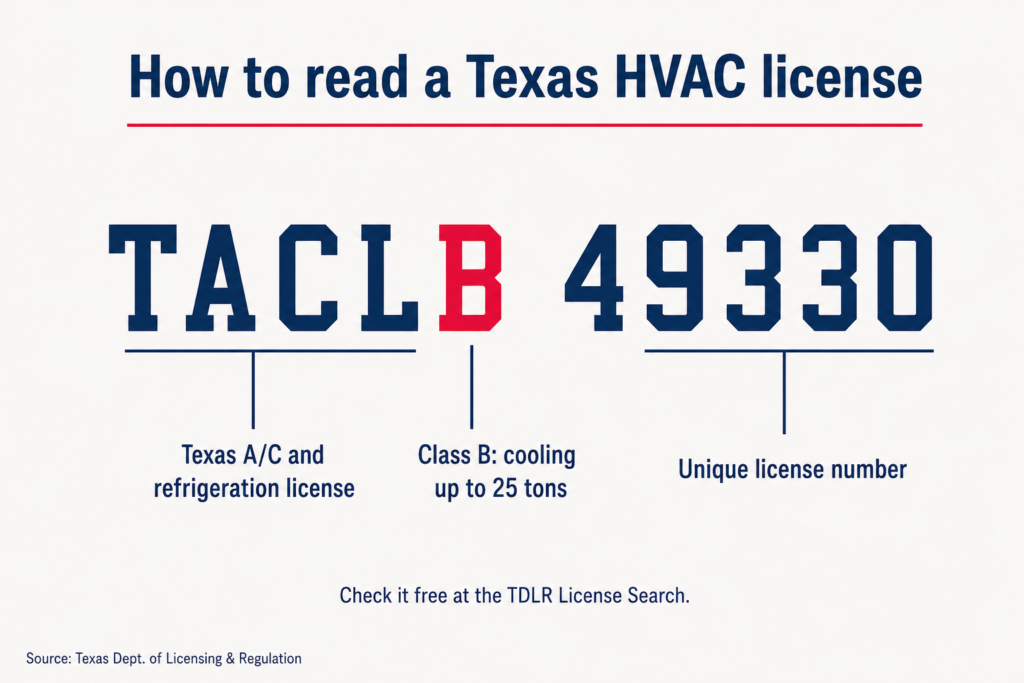
You can confirm any contractor’s license for free at the TDLR License Search. No account is required. Search by company name, city, or license number, then confirm:

  • The status reads Active, not Expired, Inactive, Suspended, or Revoked.
  • The name on the license matches the company you’re hiring.
  • The class and endorsement fit the work. Residential comfort work needs the environmental air conditioning endorsement.
  • Clicking through the record can reveal any enforcement history.

Texas licenses are valid for one year and require eight hours of continuing education to renew, so an active license also tells you the contractor is keeping current. If a company can’t or won’t give you a license number to look up, that alone is reason to stop. You can see how we present our own credentials on our qualifications page.

Ask about technician certifications, not just the company license

The company license is the floor. The people who actually show up should carry their own credentials. Think of it as a stack:

  • TDLR technician registration or certification. Anyone assisting a licensed ACR contractor with repair or maintenance must at minimum be a Registered Technician with TDLR. A Certified Technician is a higher, voluntary tier that requires 24 months of experience or an approved training program.
  • EPA Section 608 certification. Federal law, under Section 608 of the Clean Air Act, requires any technician who handles refrigerant to be EPA-certified. Type II covers most residential AC and heat pump work using R-410A. These credentials do not expire, and you can ask to see the card.
  • NATE certification. North American Technician Excellence is voluntary and widely treated as the competence standard. The U.S. Department of Energy notes that NATE has certified more than 35,000 technicians and that contractors prefer NATE-certified techs because the work gets done correctly the first time. Our technicians are NATE-certified.

Trade-association membership, like the Texas Air Conditioning Contractors Association, is a secondary signal that a contractor stays engaged with the industry rather than a credential to hang the whole decision on.

Make sure the contractor is insured

A Texas ACR license already requires the contractor to carry continuous commercial general liability insurance for as long as the license is active. For Class B contractors, that means at least $100,000 per occurrence. If a contractor’s coverage lapses, they are in violation and can’t legally contract with the public.

Ask for a Certificate of Insurance, and if you want to be thorough, call the listed carrier to confirm the policy is active. This matters because if an uninsured contractor’s worker is injured on your property, or damages your home, you can end up exposed. One phone call removes that risk.

Insist on a load calculation before any new system
The cleanest test of whether you’re dealing with a technician or a salesperson is simple. Ask whether they will perform a load calculation before sizing a new system, and whether you can see it.

The industry standard is the ACCA Manual J residential load calculation, an ANSI-recognized method that sizes equipment to your home based on square footage, insulation, windows, orientation, and Houston’s climate. A correct load calculation is required by national building codes for new installations. Matching the old unit’s tonnage or eyeballing it from the curb is not the same thing.

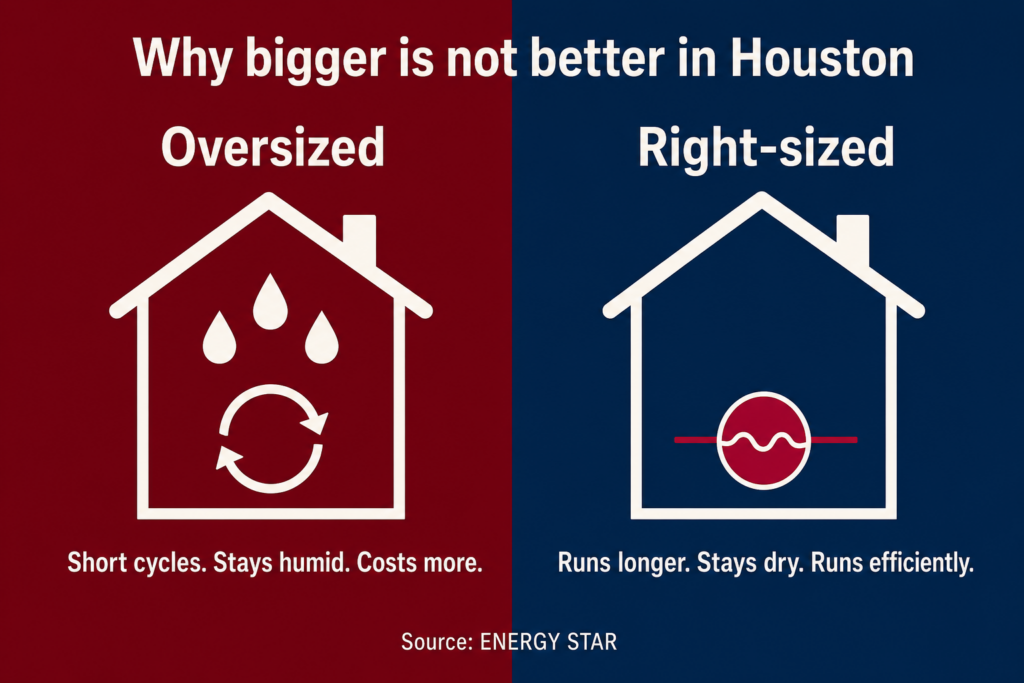
Bigger is not better, and in Houston it is actively worse. An oversized air conditioner cools the air fast but shuts off before it runs long enough to pull humidity out, a problem called short cycling. According to ENERGY STAR, an oversized unit leaves a home damp and clammy, creates uneven temperatures, wears out faster from constant stopping and starting, and costs more to run. Efficiency actually improves the longer a unit runs.

We see the consequences of oversizing constantly. On one recent call, a family had just bought a home with a 4-ton system serving a space that needed about 2 tons. That oversized equipment was the source of their chronic humidity. Right-sizing the system fixed it. If you are weighing a new system, our guide on how to select a new system walks through the same sizing logic.

Know the current efficiency standard (SEER2) in Texas
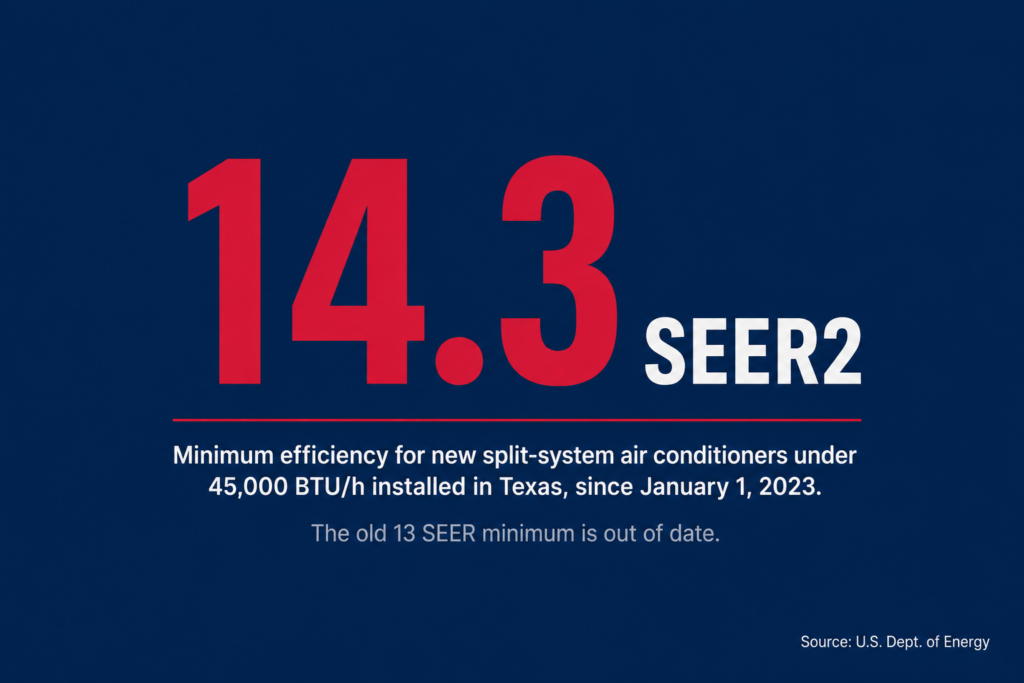
If a contractor quotes you a new system, the efficiency rating should meet current federal minimums. As of January 1, 2023, new split-system air conditioners installed in the southern region, which includes Texas, must meet at least 14.3 SEER2 for systems under 45,000 BTU per hour. SEER2 is the updated rating from a test procedure that better reflects real ductwork, so the numbers run a little lower than the old SEER scale. The “13 SEER minimum” figure you will still see quoted around the web is out of date.

You don’t need to memorize the math. Confirm any proposed system meets the 14.3 SEER2 floor, and ask the contractor to state the SEER2 rating in writing on the estimate.

Get written, itemized estimates from more than one contractor

A legitimate estimate is in writing and itemized. The Federal Trade Commission advises that an estimate should describe the work, the materials, the completion date, and the price, and that the contract should include the contractor’s name, address, phone, and license number. For any system replacement, get two or three written estimates and compare them line by line: parts, labor, and diagnostic fees broken out separately.

The FTC also warns against automatically choosing the lowest bidder, since a lowball number can be bait to get in the door, and against any contractor who pressures you for an immediate decision or wants full payment up front in cash. Refusal to itemize is its own warning sign. The Texas Attorney General offers similar guidance for home-improvement work: get bids in writing from more than one person and insist on a written contract.

Watch for pressure to replace when a repair would do
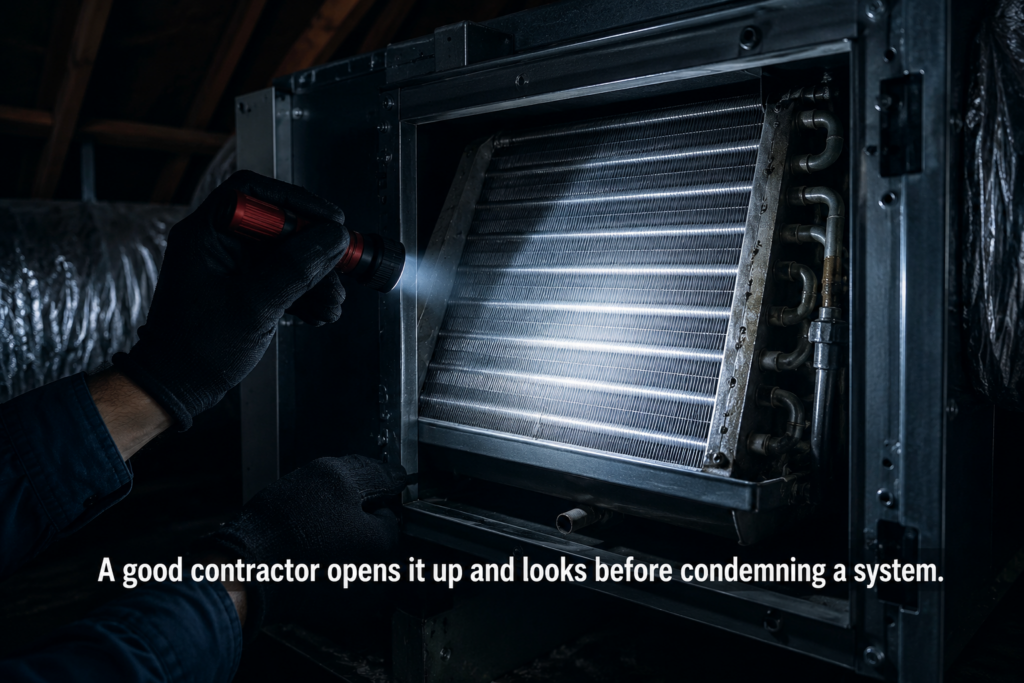
The most common high-pressure tactic in this trade is condemning a system that doesn’t need replacing. It usually follows the same script. A low-cost tune-up or free inspection gets a technician in the door, then working parts get called bad and the numbers get steered so a whole new system looks like the smart buy. The single best defense is a second opinion before any full replacement.

A thorough contractor opens the equipment and looks before writing a system off. We were once called for a second opinion on a home that was for sale, after another company claimed biological growth had spread through the system and the ductwork and that the whole thing needed to be replaced. We opened the unit up. The inside was clean. There was no biological growth on the coil or in the ductwork, and no replacement was needed. The lesson for any homeowner: you can’t judge what’s inside a system from the outside, and a contractor should look before condemning it.

Honesty sometimes costs us the job, and that is the point. We once found a failed compressor on a system that was only two years old. Rather than quote the repair, we noticed the home was still inside the builder’s labor warranty and pointed the homeowner to file under it. The work got done at no cost to them, and we walked away from a paid job. That is the standard a repair-first contractor holds. Our repair or replace guide lays out how we think through that decision.

When does replacement actually make sense?

None of this means replacement is never the answer. A failed compressor on an out-of-warranty system, repeated and escalating repair bills, or an aging system still running phased-out R-22 refrigerant can all make replacement the more sensible financial choice. The honest version of that conversation compares the cost of repair against the cost of replacement. It never claims a repair is impossible.

Technician vs. salesperson: red flags to watch for

The behaviors below separate a contractor focused on the work from one focused on the sale. Use them as a quick gut check during any visit.

What an honest contractor doesWhat a sales-driven shop does
Gives you a license number to verifyDodges questions about licensing
Opens the equipment and shows you the problemCondemns the system from the curb or the attic door
Performs a load calculation before sizing a new systemQuotes a tonnage off the top of their head
Provides a written, itemized estimateWon’t put numbers in writing
Recommends the least costly fix that worksSteers you toward a full replacement first
Welcomes a second opinionPressures you to decide today
Pulls the permit and schedules inspectionAsks you to pull the permit, or skips it

Confirm the contractor pulls the Houston permit

In the City of Houston, replacing an HVAC system requires a mechanical permit, and the licensed contractor is the one who pulls it. The Houston Permitting Center lists AC replacement, condenser replacement, evaporator replacement, and furnace replacement among the jobs that require a permit and a city inspection. Permitting confirms the system is properly sized and installed and that the contractor is state-licensed and city-registered.

If a contractor suggests skipping the permit or asks you to pull it yourself, treat that as a red flag. The FTC lists asking the homeowner to get the permits among the signs of a home-improvement scam. One caveat: homes in unincorporated Harris County, outside Houston city limits, may fall under different permitting rules, so confirm whether your address is inside the city.

Check reviews, reputation, and local track record

Reviews round out the picture, but read them for substance, not just star counts. Look for patterns: how a company responds to problems, whether reviewers mention being pushed toward replacements, and whether the same technicians get named repeatedly. A long, consistent local track record is harder to fake than a wall of five-star badges.

Be a little skeptical of award-heavy marketing. An award badge is not the same as an active license, and it’s the license you can actually verify. A contractor’s history in your area also tells you they will still be around when you need warranty work or a maintenance visit next year. We’ve served the greater Houston area since 1956 as a family-owned and veteran-owned company, and you can read our client reviews and our story to see that track record for yourself.

Frequently asked questions

What license should a Houston HVAC contractor have? An active Air Conditioning and Refrigeration (ACR) Contractor License from TDLR, shown as a TACLA or TACLB number. You can verify it for free at the TDLR License Search and confirm the status reads Active.

How many estimates should I get for an AC replacement? Get two or three written, itemized estimates and compare parts, labor, and diagnostic fees separately. Multiple quotes are the best defense against an unnecessary-replacement pitch.

Do I need a permit to replace my AC in Houston? Yes. Replacing an HVAC system inside Houston city limits requires a mechanical permit, and your licensed contractor should pull it and schedule the city inspection.

Should I get a second opinion before replacing my HVAC system? Yes, especially if a contractor recommends full replacement at the first sign of trouble. A second opinion is the simplest way to confirm whether a repair would solve the problem.

Choosing a contractor you can trust

The fastest way to tell a technician from a salesperson is to put these criteria to work: verify the license, ask to see certifications and the load calculation, get the estimate in writing, and ask for a second opinion before you replace anything. An honest contractor will be glad you did.

If you’re in the Houston area and want a straight answer about a repair or a replacement, we’re happy to take a look. We answer our phones 24/7 with no after-hours or weekend upcharge, and our estimates are free. Contact us or request service and we’ll help you sort out the right next step.

The most reliable way to choose an HVAC contractor in Houston is to verify a short list of things any homeowner can confirm on their own: an active Texas license, the right technician certifications, proof of insurance, a real load calculation before any new equipment, and a clear written estimate you can compare against others. Get those right, and one question answers itself. Are you hiring a technician or a salesperson?

At Spring Branch AC, we’ve serviced Houston-area homes since 1956 under Texas license TACLB49330E, a number you can look up yourself in about a minute. We run a repair-first shop with no commissioned salespeople, which shapes how we think about this entire decision. The criteria below are the same ones we’d want our own family to use, whether they hire us or someone else.

The real question: are you hiring a technician or a salesperson?

A licensed company can still send a salesperson to your door. The difference shows up in behavior. A technician diagnoses the actual problem, opens the equipment to look before condemning anything, and recommends the least expensive fix that solves it. A sales-driven operation arrives looking for a reason to sell you a new system.

Every criterion that follows maps to something you can verify with a phone, a website, and a willingness to ask. An honest contractor welcomes those questions. A salesperson gets cagey. The same split runs through every point below.

Verify the Texas HVAC contractor license first

This is the non-negotiable first step. In Texas, residential HVAC companies must hold an active Air Conditioning and Refrigeration (ACR) Contractor License issued by the Texas Department of Licensing and Regulation (TDLR). The license is held at the company level, and it is the single most verifiable thing about any contractor you’re considering.

Texas issues two classes. Class A covers units of any size. Class B covers cooling systems up to 25 tons and heating up to 1.5 million BTU per hour, which covers virtually all residential work. License numbers read as TACLA (Class A) or TACLB (Class B) followed by digits. Ours, TACLB49330E, is a Class B license with the environmental air conditioning endorsement that covers home comfort systems.

How to check an HVAC contractor’s license in Texas

You can confirm any contractor’s license for free at the TDLR License Search. No account is required. Search by company name, city, or license number, then confirm:

  • The status reads Active, not Expired, Inactive, Suspended, or Revoked.
  • The name on the license matches the company you’re hiring.
  • The class and endorsement fit the work. Residential comfort work needs the environmental air conditioning endorsement.
  • Clicking through the record can reveal any enforcement history.

Texas licenses are valid for one year and require eight hours of continuing education to renew, so an active license also tells you the contractor is keeping current. If a company can’t or won’t give you a license number to look up, that alone is reason to stop. You can see how we present our own credentials on our qualifications page.

Ask about technician certifications, not just the company license

The company license is the floor. The people who actually show up should carry their own credentials. Think of it as a stack:

  • TDLR technician registration or certification. Anyone assisting a licensed ACR contractor with repair or maintenance must at minimum be a Registered Technician with TDLR. A Certified Technician is a higher, voluntary tier that requires 24 months of experience or an approved training program.
  • EPA Section 608 certification. Federal law, under Section 608 of the Clean Air Act, requires any technician who handles refrigerant to be EPA-certified. Type II covers most residential AC and heat pump work using R-410A. These credentials do not expire, and you can ask to see the card.
  • NATE certification. North American Technician Excellence is voluntary and widely treated as the competence standard. The U.S. Department of Energy notes that NATE has certified more than 35,000 technicians and that contractors prefer NATE-certified techs because the work gets done correctly the first time. Our technicians are NATE-certified.

Trade-association membership, like the Texas Air Conditioning Contractors Association, is a secondary signal that a contractor stays engaged with the industry rather than a credential to hang the whole decision on.

Make sure the contractor is insured

A Texas ACR license already requires the contractor to carry continuous commercial general liability insurance for as long as the license is active. For Class B contractors, that means at least $100,000 per occurrence. If a contractor’s coverage lapses, they are in violation and can’t legally contract with the public.

Ask for a Certificate of Insurance, and if you want to be thorough, call the listed carrier to confirm the policy is active. This matters because if an uninsured contractor’s worker is injured on your property, or damages your home, you can end up exposed. One phone call removes that risk.

Insist on a load calculation before any new system

The cleanest test of whether you’re dealing with a technician or a salesperson is simple. Ask whether they will perform a load calculation before sizing a new system, and whether you can see it.

The industry standard is the ACCA Manual J residential load calculation, an ANSI-recognized method that sizes equipment to your home based on square footage, insulation, windows, orientation, and Houston’s climate. A correct load calculation is required by national building codes for new installations. Matching the old unit’s tonnage or eyeballing it from the curb is not the same thing.

Bigger is not better, and in Houston it is actively worse. An oversized air conditioner cools the air fast but shuts off before it runs long enough to pull humidity out, a problem called short cycling. According to ENERGY STAR, an oversized unit leaves a home damp and clammy, creates uneven temperatures, wears out faster from constant stopping and starting, and costs more to run. Efficiency actually improves the longer a unit runs.

We see the consequences of oversizing constantly. On one recent call, a family had just bought a home with a 4-ton system serving a space that needed about 2 tons. That oversized equipment was the source of their chronic humidity. Right-sizing the system fixed it. If you are weighing a new system, our guide on how to select a new system walks through the same sizing logic.

Know the current efficiency standard (SEER2) in Texas

If a contractor quotes you a new system, the efficiency rating should meet current federal minimums. As of January 1, 2023, new split-system air conditioners installed in the southern region, which includes Texas, must meet at least 14.3 SEER2 for systems under 45,000 BTU per hour. SEER2 is the updated rating from a test procedure that better reflects real ductwork, so the numbers run a little lower than the old SEER scale. The “13 SEER minimum” figure you will still see quoted around the web is out of date.

You don’t need to memorize the math. Confirm any proposed system meets the 14.3 SEER2 floor, and ask the contractor to state the SEER2 rating in writing on the estimate.

Get written, itemized estimates from more than one contractor

A legitimate estimate is in writing and itemized. The Federal Trade Commission advises that an estimate should describe the work, the materials, the completion date, and the price, and that the contract should include the contractor’s name, address, phone, and license number. For any system replacement, get two or three written estimates and compare them line by line: parts, labor, and diagnostic fees broken out separately.

The FTC also warns against automatically choosing the lowest bidder, since a lowball number can be bait to get in the door, and against any contractor who pressures you for an immediate decision or wants full payment up front in cash. Refusal to itemize is its own warning sign. The Texas Attorney General offers similar guidance for home-improvement work: get bids in writing from more than one person and insist on a written contract.

Watch for pressure to replace when a repair would do

The most common high-pressure tactic in this trade is condemning a system that doesn’t need replacing. It usually follows the same script. A low-cost tune-up or free inspection gets a technician in the door, then working parts get called bad and the numbers get steered so a whole new system looks like the smart buy. The single best defense is a second opinion before any full replacement.

A thorough contractor opens the equipment and looks before writing a system off. We were once called for a second opinion on a home that was for sale, after another company claimed biological growth had spread through the system and the ductwork and that the whole thing needed to be replaced. We opened the unit up. The inside was clean. There was no biological growth on the coil or in the ductwork, and no replacement was needed. The lesson for any homeowner: you can’t judge what’s inside a system from the outside, and a contractor should look before condemning it.

Honesty sometimes costs us the job, and that is the point. We once found a failed compressor on a system that was only two years old. Rather than quote the repair, we noticed the home was still inside the builder’s labor warranty and pointed the homeowner to file under it. The work got done at no cost to them, and we walked away from a paid job. That is the standard a repair-first contractor holds. Our repair or replace guide lays out how we think through that decision.

When does replacement actually make sense?

None of this means replacement is never the answer. A failed compressor on an out-of-warranty system, repeated and escalating repair bills, or an aging system still running phased-out R-22 refrigerant can all make replacement the more sensible financial choice. The honest version of that conversation compares the cost of repair against the cost of replacement. It never claims a repair is impossible.

Technician vs. salesperson: red flags to watch for

The behaviors below separate a contractor focused on the work from one focused on the sale. Use them as a quick gut check during any visit.

What an honest contractor doesWhat a sales-driven shop does
Gives you a license number to verifyDodges questions about licensing
Opens the equipment and shows you the problemCondemns the system from the curb or the attic door
Performs a load calculation before sizing a new systemQuotes a tonnage off the top of their head
Provides a written, itemized estimateWon’t put numbers in writing
Recommends the least costly fix that worksSteers you toward a full replacement first
Welcomes a second opinionPressures you to decide today
Pulls the permit and schedules inspectionAsks you to pull the permit, or skips it

Confirm the contractor pulls the Houston permit

In the City of Houston, replacing an HVAC system requires a mechanical permit, and the licensed contractor is the one who pulls it. The Houston Permitting Center lists AC replacement, condenser replacement, evaporator replacement, and furnace replacement among the jobs that require a permit and a city inspection. Permitting confirms the system is properly sized and installed and that the contractor is state-licensed and city-registered.

If a contractor suggests skipping the permit or asks you to pull it yourself, treat that as a red flag. The FTC lists asking the homeowner to get the permits among the signs of a home-improvement scam. One caveat: homes in unincorporated Harris County, outside Houston city limits, may fall under different permitting rules, so confirm whether your address is inside the city.

Check reviews, reputation, and local track record

Reviews round out the picture, but read them for substance, not just star counts. Look for patterns: how a company responds to problems, whether reviewers mention being pushed toward replacements, and whether the same technicians get named repeatedly. A long, consistent local track record is harder to fake than a wall of five-star badges.

Be a little skeptical of award-heavy marketing. An award badge is not the same as an active license, and it’s the license you can actually verify. A contractor’s history in your area also tells you they will still be around when you need warranty work or a maintenance visit next year. We’ve served the greater Houston area since 1956 as a family-owned and veteran-owned company, and you can read our client reviews and our story to see that track record for yourself.

Frequently asked questions

What license should a Houston HVAC contractor have? An active Air Conditioning and Refrigeration (ACR) Contractor License from TDLR, shown as a TACLA or TACLB number. You can verify it for free at the TDLR License Search and confirm the status reads Active.

How many estimates should I get for an AC replacement? Get two or three written, itemized estimates and compare parts, labor, and diagnostic fees separately. Multiple quotes are the best defense against an unnecessary-replacement pitch.

Do I need a permit to replace my AC in Houston? Yes. Replacing an HVAC system inside Houston city limits requires a mechanical permit, and your licensed contractor should pull it and schedule the city inspection.

Should I get a second opinion before replacing my HVAC system? Yes, especially if a contractor recommends full replacement at the first sign of trouble. A second opinion is the simplest way to confirm whether a repair would solve the problem.

Choosing a contractor you can trust

The fastest way to tell a technician from a salesperson is to put these criteria to work: verify the license, ask to see certifications and the load calculation, get the estimate in writing, and ask for a second opinion before you replace anything. An honest contractor will be glad you did.

If you’re in the Houston area and want a straight answer about a repair or a replacement, we’re happy to take a look. We answer our phones 24/7 with no after-hours or weekend upcharge, and our estimates are free. Contact us or request service and we’ll help you sort out the right next step.

Previous Post
Next Post

Contact Spring Branch AC

Free estimates available. Licensed, insured, and ready to help.

Scroll to Top