


By Chris Crawford, Owner of Spring Branch AC & Plumbing
Private equity firms have been buying heating, air conditioning and plumbing companies for several years, so the company you call for a repair may be owned by investors you’ve never heard of. I couldn’t find any study that ties that ownership to higher prices. In my experience, the bigger risk to your bill is being quoted a whole new system when a repair would have fixed the problem. Whether that happens depends on who the company sends to your house: a technician who finds the problem and fixes it, or a salesperson whose job is to sell equipment. You can usually find out which one is coming before you book by asking a few questions.
I’m Chris Crawford, owner of Spring Branch AC & Plumbing, a veteran-owned company in Houston. We don’t have any salespeople. Our technicians diagnose problems and repair them. I made a short video about this. It opens with the question I’d ask any homeowner: “Who do you think is coming out to your house today?” The full transcript is at the end.
What is a private equity HVAC company?
A private equity HVAC company is a heating and air conditioning company (often a plumbing company too) that has been bought by a private equity firm. A private equity firm is an investment company. It raises money from investors, buys businesses, and later sells them for more than it paid.
Many of these firms build what’s called a roll-up. They buy one company, then keep buying local companies and combine them under one owner. The companies they buy often keep running under their own local names, so the name on the truck may not tell you who owns the business.
How many HVAC companies are owned by private equity?
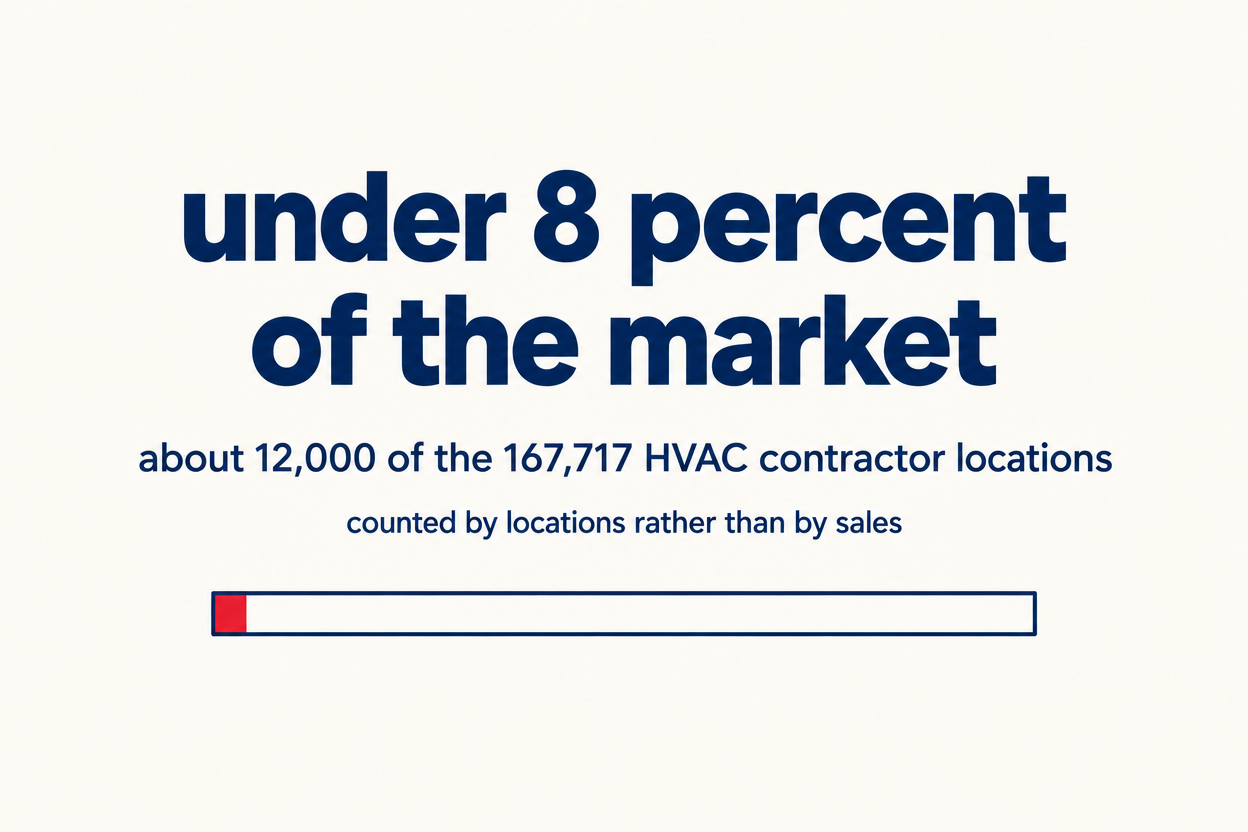
One data company that tracks the industry estimates that ten of the private equity companies buying in this industry own about 12,000 HVAC contractor locations in the U.S. The data company tracks 167,717 locations in all, so it puts those ten at “under 8 percent of the market.” In its words, “The other 155,000 are still independent.” Those numbers are the data company’s own estimate. No one publishes a number for Houston.
What changes after a private equity firm buys an HVAC company?
After a buyout, the change a homeowner is most likely to notice is who the company sends to the house and what that person is there to do. In my experience, when these firms buy a smaller company, the technicians are often the first people let go. As I put it in my video, “They would rather have sales people come in, train them just enough on air conditioning and plumbing and electrical to be dangerous.” Those salespeople are there to sell equipment rather than to diagnose the problem.
Others in the trade describe the same pattern:
- Technicians handing calls to salespeople. John Bottala, who runs a plumbing company in California, told a plumbing trade magazine in 2026, “What I’ve been seeing is a lot of ‘tech lead generated calls.'” He explained that the technician at the house flags the job for the company’s salespeople, and the company sends a salesperson to the house to sell additional work, whether or not the client needs it.
- Experienced technicians cut. Wellington Santana, who co-runs an HVAC company in Las Vegas, told an HVAC trade magazine in 2026, “The PE firms come in, cut the experienced techs, and flip the company in three years.”
- Bigger equipment than the house needed. Jeff Howard, an HVAC engineer interviewed in a 2023 report, described the equipment his company installed after it was bought: “They upsized the equipment, oversold it, said it was going to take care of all their problems.”
These are personal accounts and reporting, not studies. Bottala and Santana both run independent companies and are critical of private equity, so they aren’t neutral observers. Some companies owned by private equity employ good technicians, and some independent companies push equipment sales on service calls. In my view, knowing whether a company sends a technician or a salesperson to your house tells you more about how your repair will go than knowing who owns the company.
Technician or salesperson: who’s coming to your house?
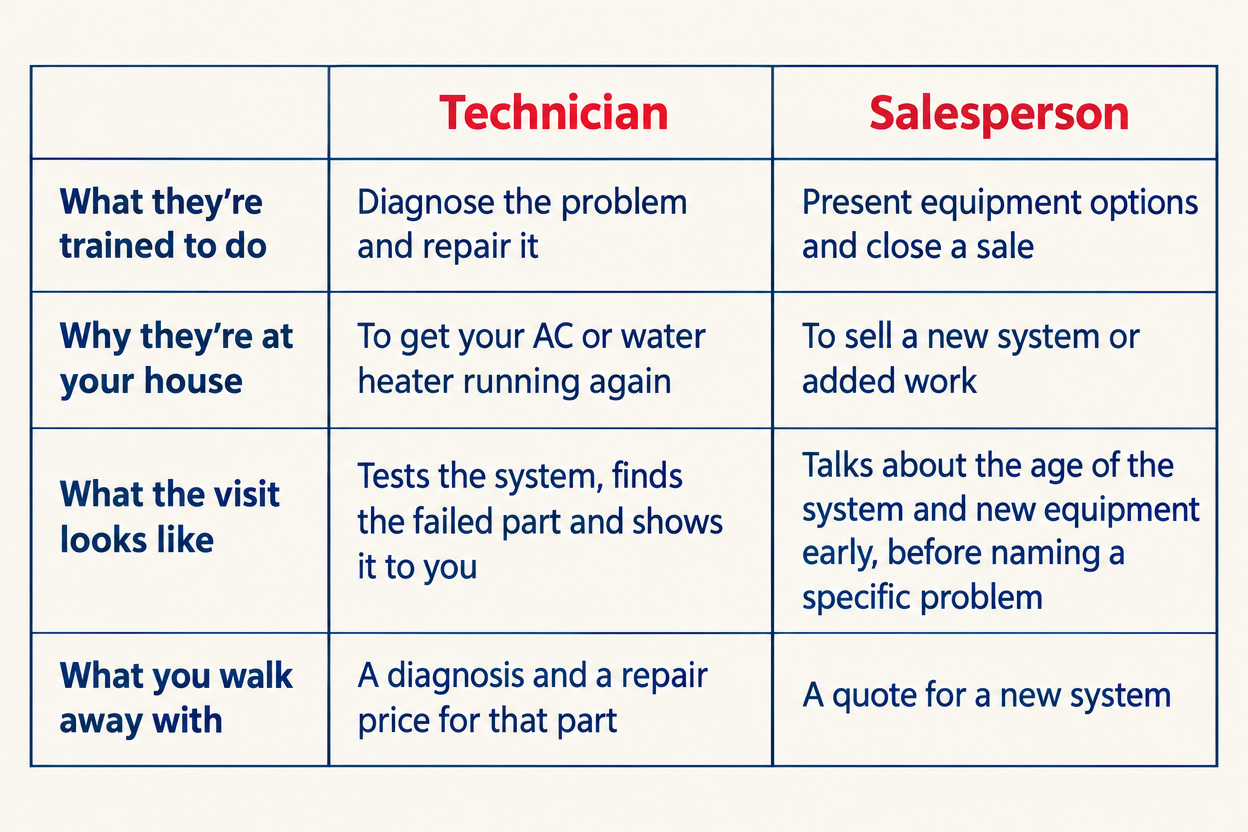
A technician comes to find out what’s wrong and fix it. A salesperson comes to sell you something, and a new system is usually the biggest sale. Some companies give their salespeople friendlier titles, so the title on the business card won’t always tell you which one you’ve got. You can tell by what the person does during the visit.
| Technician | Salesperson | |
|---|---|---|
| What they’re trained to do | Diagnose the problem and repair it | Present equipment options and close a sale |
| Why they’re at your house | To get your AC or water heater running again | To sell a new system or added work |
| What the visit looks like | Tests the system, finds the failed part and shows it to you | Talks about the age of the system and new equipment early, before naming a specific problem |
| What you walk away with | A diagnosis and a repair price for that part | A quote for a new system |
If the conversation turns to a new system before anyone has told you what’s actually broken, you’re probably talking to a salesperson. You can ask for the diagnosis and a repair price first, and then decide. Our guide on how to choose the right HVAC contractor in Houston has more of the red flags to watch for.
Questions to ask before you book an AC or plumbing repair
These questions, asked on the phone before anyone comes out, tell you who’s coming and what they’re there to do:
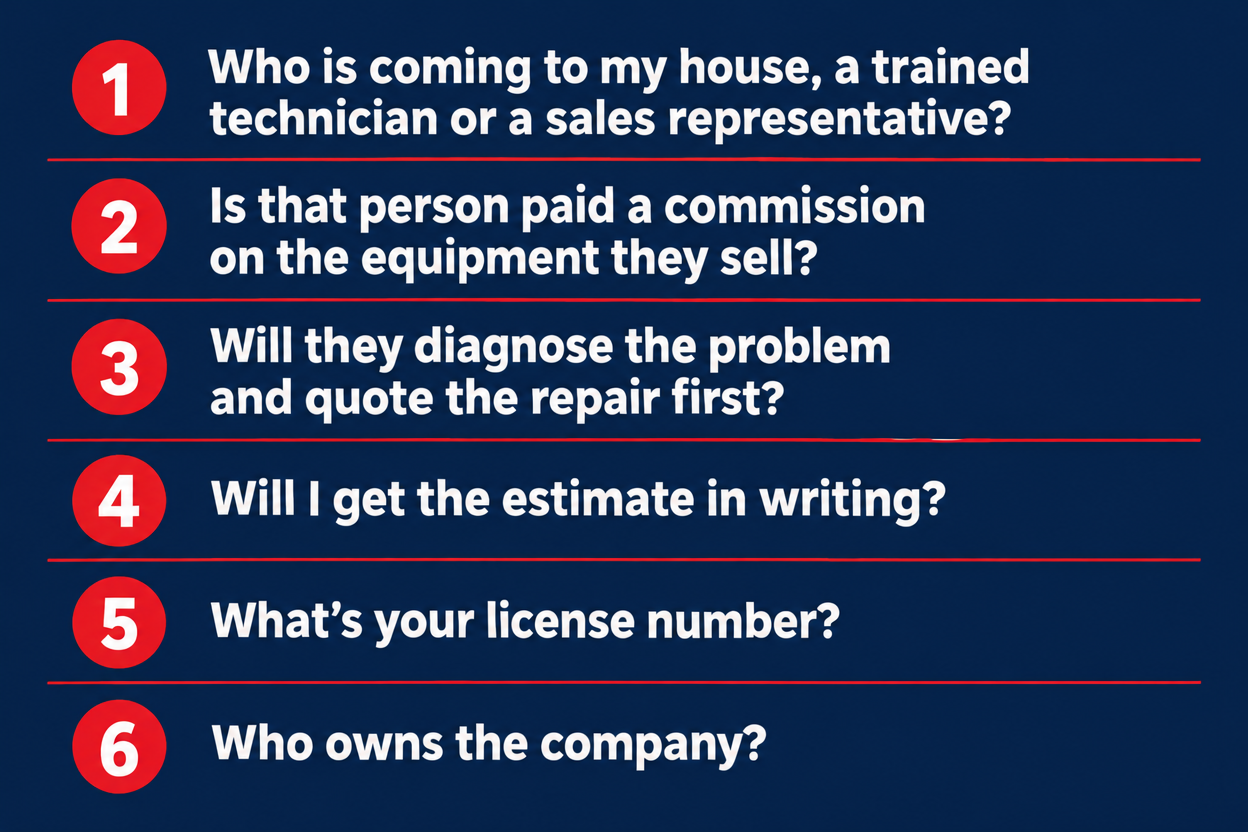
- Who is coming to my house, a trained technician or a sales representative? You want someone who’s trained to diagnose and repair.
- Is that person paid a commission on the equipment they sell? Commission doesn’t make someone dishonest, but you should know if the person looking at your system earns more when you buy a new one.
- Will they diagnose the problem and quote the repair first? The answer you want is a plain yes: they’ll find what’s wrong and give you a price to fix it before anyone talks about new equipment.
- Will I get the estimate in writing? A written estimate names the problem and the price, so you can compare it or get a second opinion before you agree to anything.
- What’s your license number? A company doing AC work in Texas should be able to give it to you right away.
- Who owns the company? It’s fair to ask. The answer won’t tell you everything, but a company that’s comfortable answering is a good sign.
How to check a Texas AC license
A company that repairs air conditioning in Texas works under an air conditioning and refrigeration contractor license from the Texas Department of Licensing and Regulation (TDLR). Technicians can hold their own TDLR registration or certification, but TDLR says they “must work under the supervision of a licensed air conditioning and refrigeration contractor.” So the license to check is the company’s. Here’s how:
- Open TDLR’s license search.
- Search by the company’s license number, or by its business name, city, county or ZIP code.
- If the company doesn’t come up, ask the company for its license number and search again. The license may be listed under a different business name than the one on the truck. The search also shows active licenses only, so an expired license won’t come up. You can also call TDLR, and they can tell you whether the company holds an active license.
Our Texas HVAC license is TACLB49330E if you’d like to try the search with it.
How we handle repair calls at Spring Branch
At Spring Branch, the person who comes to your house is a technician. We don’t have salespeople, and our technicians aren’t paid on commission. They’re NATE-certified, which is a national certification for HVAC technicians. They’re also cross-trained in HVAC and plumbing, so the same person can look at your AC or your water heater. You can see their certifications and qualifications here.
When our technician gets to your house, the job is to diagnose the problem and fix it. If a system has reached the point where replacing it makes more sense than repairing it, they’ll walk you through both options and let you decide. Repair always comes first. Our page on whether to repair or replace explains how we think about that.
I don’t think a sales visit is what you’re expecting when you call a service company. If you ever need us, give us a shout at (713) 937-6739, and we’ll send a technician to take a look.
Video Transcript
Hey everybody, Chris Crawford at Spring Branch Air Conditioning & Plumbing.
Let’s say that your AC’s not working right or your water heater’s not working right. Call over to a service company and say, “Hey, need somebody to come out and take a look.” Who do you think is coming out to your house today? It’s a decent question, right?
You would think technician, somebody that’s been trained, knows what to look at, knows how to diagnose what the problems are, what parts need to be changed up to get the unit back up and running. Right? That’s kind of who you’re expecting.
But in today’s world, quite often, that is not the case. Especially if you’re calling one of these companies that are now owned by a private equity organization.
So, at Spring Branch, we don’t have any sales people. Our guys are technicians, just that guy that we just described, right? Trained, knows what to look at, can get your system fixed, back up and running.
But these private equity organizations, they’re not hiring technicians. In fact, when they buy one of these organizations, one of these companies, these smaller companies, in many cases, those are the first people that are let go, the technicians. They would rather have sales people come in, train them just enough on air conditioning and plumbing and electrical to be dangerous, so they know the nomenclature, they kind of sort of know what they’re talking about. But as far as diagnosing and all that neat stuff, that’s normally not the case. They’re there to sell you equipment, high ticket prices with high profit margins, so they can pay high overhead. And so, that’s what those guys are for.
We don’t do that at Spring Branch. I don’t think that’s what you’re expecting typically when you call a service company.
So, be careful out there. It’s a different world than what it was just a few years ago.
If you ever need us, give us a shout. Spring Branch AC & Plumbing, (713) 937-6739 or you can find us online anytime springbranchac.com. Bye guys.