

By Chris Crawford, Owner of Spring Branch AC
A typical AC system takes two surge protectors, and the devices for both cost about $100 to $300. That’s less than the $350 to $650 a typical control board replacement costs. For most Houston homes, that makes surge protection worth having. It matters most on a newer high-efficiency system, because its electronics are the most easily damaged by a power spike. Many HVAC surge protectors won’t protect against lightning, and none can stop a direct strike. They also wear out eventually, often without any sign that they have.
At Spring Branch AC, we’ve been servicing and installing heating and cooling systems in Houston since 1956. We include surge protectors in the standard price of every new high-efficiency system we install.
What does an HVAC surge protector do?
An HVAC surge protector sits on the power line that feeds your heating and cooling equipment and limits sudden jumps in voltage. When a spike arrives on that line, the protector diverts the extra voltage away from the system’s circuit boards. It protects only that equipment, not the rest of the house.
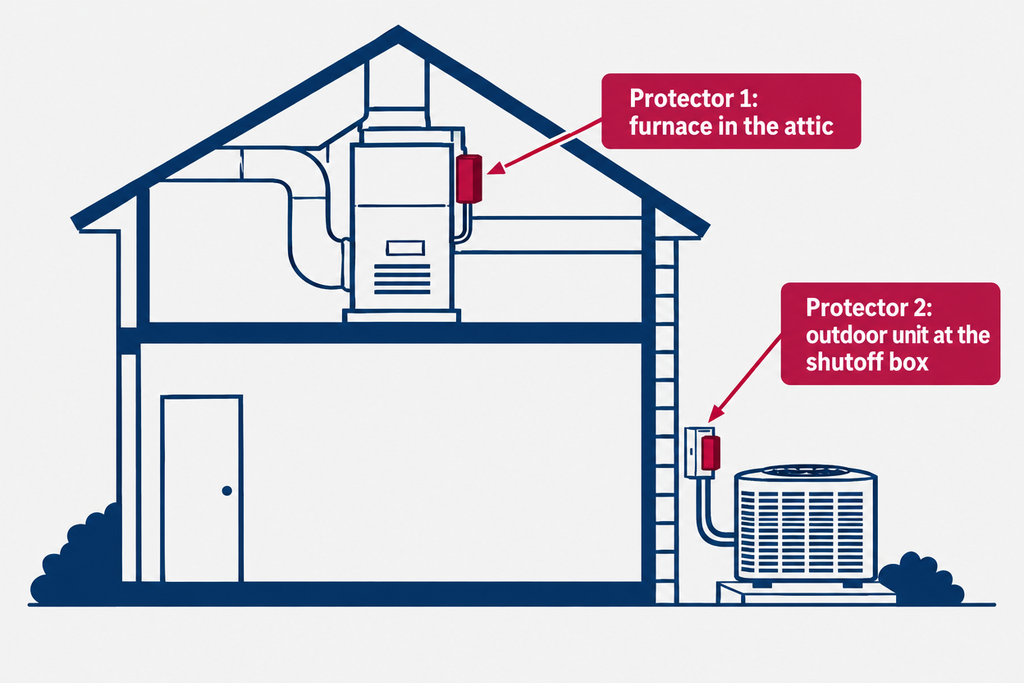
A typical install uses two protectors, because a typical system has equipment in two places, and each piece has its own electronics. One protector goes on the furnace in the attic. The other goes on the outdoor unit, mounted at the power shutoff box on the wall beside it.
You can see the protectors we carry on our surge protectors page.
How does a power surge damage an AC?
A power surge damages an AC when more voltage than its electronics can handle reaches the circuit boards, motors and compressor. Storms cause some surges. Problems on the power grid cause more of them than weather does, according to HVAC School. Those spikes happen often.
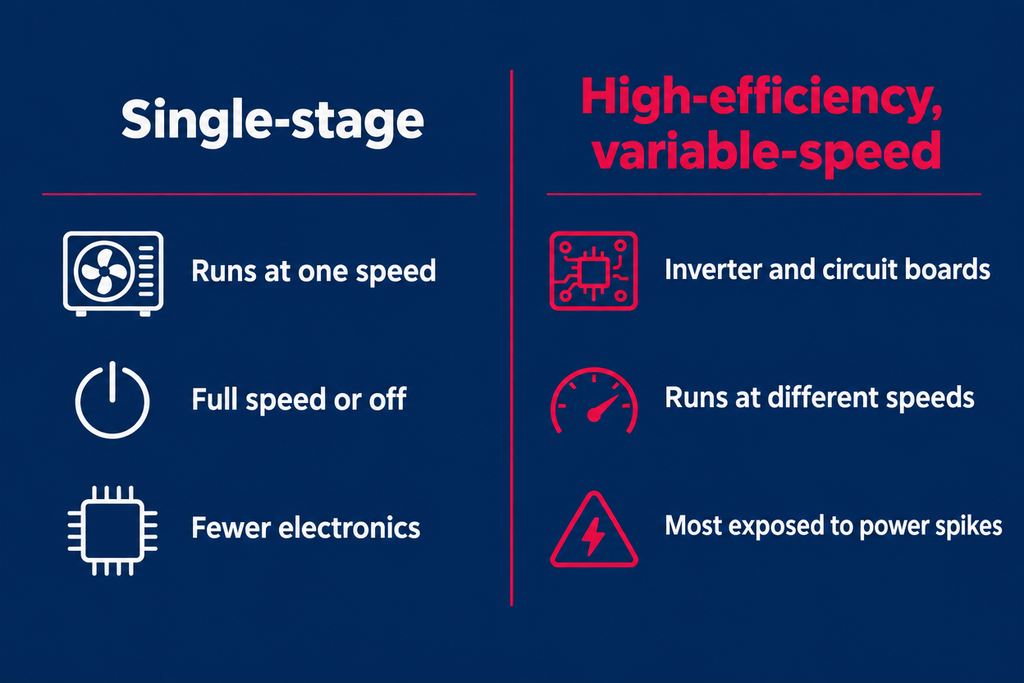
Newer high-efficiency systems are the most exposed. These systems convert the power coming into your house into a different kind of power to run their motors and compressor. A part called an inverter does that conversion. The inverter is what lets the compressor run at different speeds, instead of only at full speed or off.
The inverter and the control boards are built from the same kind of electronic parts as a computer. Matthew Bruner of HVAC School explains that those parts are more sensitive to overvoltage than other electrical components. The circuit boards are the parts a surge is most likely to damage.
Equipment can also wear down from many small surges over time, not only from one big one, according to HVAC School.
Which AC systems need a surge protector most?
High-efficiency, variable-speed systems need a surge protector most, because they run on an inverter and circuit boards that are both sensitive to spikes and expensive to replace.
- High-efficiency, variable-speed system: strongly recommended.
- Standard single-stage system: still recommended, but less critical. A single-stage system runs at one speed and switches fully on or off. It has fewer electronics for a surge to damage.
If you’re not sure which kind you have, a technician can tell you when they look at your equipment.
HVAC surge protector vs whole-home surge protector: do I need both?
Get both a whole-home surge protector and an HVAC surge protector if you can, because they sit in different places and catch different surges. A whole-home protector mounts at your main electrical panel and stops spikes coming in from the power lines. An HVAC protector mounts at the equipment and catches spikes on the power line that feeds your heating and cooling equipment. Jon Harrod, writing for Green Building Advisor, notes that surge protection at the main panel may not protect against surges that start inside the home.
| Whole-home surge protector | HVAC surge protector | |
|---|---|---|
| Where it sits | At the main electrical panel | At the furnace in the attic and at the outdoor unit |
| What it protects | The whole house from surges coming in on the utility line | Your heating and cooling equipment |
| What it can miss | Surges that start inside the home | Everything outside the heating and cooling equipment |
| Who installs it | An electrician | An HVAC technician |
The 2020 National Electrical Code added a rule requiring a surge protector at a home’s main electrical panel, including when the main panel in an older home is replaced, according to Electrical Contractor. So a newer home, or one with a replaced main panel, probably already has a whole-home protector. An older home with its original panel may not. Either way, the code doesn’t put a protector on your AC, so you’d still want one at the equipment.
How much does an HVAC surge protector cost?
An HVAC surge protector costs about $50 to $150 for the device itself, before installation. A typical install uses two, one indoors and one outdoors, so the devices for a typical system run about $100 to $300. The figures below are national ranges, not Spring Branch AC prices.
| Item | National cost range | Source |
|---|---|---|
| HVAC surge protector (device, each) | $50 to $150 | Clean Heat Connect fact sheet |
| Whole-home surge protector, installed | $70 to $700, about $300 on average | Bob Vila |
| AC control board replacement | $120 to $1,200, typically $350 to $650 | PickHVAC |
| AC compressor replacement | $800 to $2,800, about $1,200 on average | Bob Vila |
A heat pump uses the same kind of outdoor unit as a central AC. Harrod writes that installing a protector on one takes less than 15 minutes. On a system you already own, a technician can look at your equipment and quote the protectors before doing any work.
What an HVAC surge protector won’t do
An HVAC surge protector handles short voltage spikes. It won’t help in these situations:
- Lightning. The Clean Heat Connect fact sheet states that “No device available can protect against a direct lightning strike.” HVAC School notes that many HVAC surge protectors don’t protect against lightning strikes at all.
- Low voltage or brownouts. A brownout is a drop in voltage that lasts a while. During one, motors run hotter and draw more current, according to HVAC School. A basic surge protector doesn’t help with low voltage.
- Voltage that stays too high. Voltage that stays above normal for a long time can overheat circuit boards until they fail, according to the Clean Heat Connect fact sheet. A surge protector doesn’t fix that.
- A protector that has worn out. Surge protectors don’t last forever. Many of them don’t cut power to the equipment when they fail, according to HVAC School, so your system keeps running without protection and nothing tells you. A technician can check the protectors when they look at your equipment.
Does my warranty or CenterPoint cover AC surge damage?
Check your manufacturer warranty before you count on it for surge damage, because a warranty may not cover damage from some electrical problems. The Amana limited warranty for one family of its equipment doesn’t cover lightning damage. It also doesn’t cover damage, or a unit that won’t start, caused by an interruption in electrical service or by what it calls “inadequate electrical service.” It doesn’t mention power surges by name, so whether a surge claim gets paid comes down to the wording in your own system’s warranty.
CenterPoint’s electric surge plan lists air conditioning units as covered and pays up to $1,000 a year. That’s more than a typical control board replacement and less than a typical compressor replacement, going by the table above.
Have a technician check your system
If you’re not sure whether your system has surge protection, or whether it’s the kind that needs it most, I’m happy to have one of our technicians take a look. They’re real technicians, not salespeople, so they’ll tell you what your system has and whether it needs anything. And if your system stopped working after a storm, we handle AC repair too. Give us a call at (713) 937-6739.