


How Much Does a New HVAC System Cost in Houston, TX? (2026)

How Much Does a New HVAC System Cost in Houston, TX? (2026)

How Much Does a New HVAC System Cost in Houston, TX? (2026)

How Much Does a New HVAC System Cost in Houston, TX

A complete HVAC system replacement in the Houston area typically costs $10,000 to $22,000 installed when new ductwork is part of the job, with most whole-system replacements landing in the low five figures. A national dataset of recent homeowner projects puts the 2026 average closer to $11,590 to $14,100, and a typical AC and gas furnace setup for a 2,000 to 2,500 square foot home averages around $13,430 before major add-ons. Ductwork, electrical work, premium equipment, and tricky installations push the number up from there.

At Spring Branch Air Conditioning & Heating, we’ve replaced systems for Houston-area homeowners since 1956, and we publish our own replacement pricing organized by system size and efficiency tier. We also tell people the truth about what they need, including the times they don’t need a full replacement at all. Real technicians work here, not professional salespeople, so this guide gives you straight numbers and the reasoning behind them, then shows you how to read a quote so you don’t get oversold on a five-figure decision.

What is the average cost of a new HVAC system in Houston?

For most Houston homes, a full system replacement falls in the low five figures. Here is how the most reliable sources line up:

SourceFigureWhat it covers
Houston metro estimate$10,000 to $22,000Complete HVAC replacement with new ductwork
2026 national average$11,590 to $14,100Full HVAC replacement, based on recent homeowner projects
2,000 to 2,500 sq. ft. homeAbout $13,430AC and gas furnace system before major add-ons
Simpler split-system change-out$3,750 to $7,400Narrower scope, not a whole-system job

The wide spread is the part that matters. The Houston metro range comes from an aggregator that localizes national project costs, while the $11,590 to $14,100 figure is drawn from roughly 56,000 real homeowner projects over six months. Both point to the same conclusion: budget in the low five figures for a typical whole-system replacement, and expect the final number to move based on the specifics of your home.

That low-end “$3,750 to $7,400” figure deserves a flag. It reflects a simpler split-system change-out, not a complete system replacement with ductwork and everything else. If a quote comes in well below the broader range, ask exactly what scope it includes before you assume you found a bargain.

HVAC replacement cost by system size and efficiency

Two factors drive the base equipment cost more than anything else: how big the system needs to be, measured in tons, and how efficient it is, measured in SEER2. Larger systems cost more because they use more material and bigger components. Higher-efficiency systems cost more upfront but use less energy over their life.

Equipment-only pricing climbs steadily with tonnage. National figures show roughly $2,100 for a 2-ton unit up to around $3,700 for a 5-ton unit, for the air conditioner alone. Those are equipment numbers, not installed system costs, so a finished Houston job lands well above them once you add the indoor unit, labor, materials, and permits.

Efficiency adds another layer. The federal minimum for new split-system air conditioners in the southern zone, which includes Houston, is now 14.3 SEER2. You can install at that floor or step up to higher-efficiency, two-stage, or variable-speed equipment. In Houston’s climate, that upgrade often pays back faster than it would in a cooler market, which we get into below.

We publish our own replacement pricing by system size and efficiency tier so homeowners can see real installed numbers rather than aggregator averages. The general shape of it: a smaller, single-speed system sits at the low end, and a larger, variable-speed system sits at the top. Asking for pricing laid out this way is a good habit with any contractor, because it lets you compare apples to apples.
What affects the cost of an HVAC replacement?

Two quotes for the “same size, same brand” system can still differ by thousands of dollars. Here is what moves the number:

  • System size (tonnage). Bigger systems cost more in equipment and labor. But bigger is not automatically better, which gets its own section below.
  • Efficiency rating (SEER2). Higher-efficiency equipment costs more upfront and saves more over time.
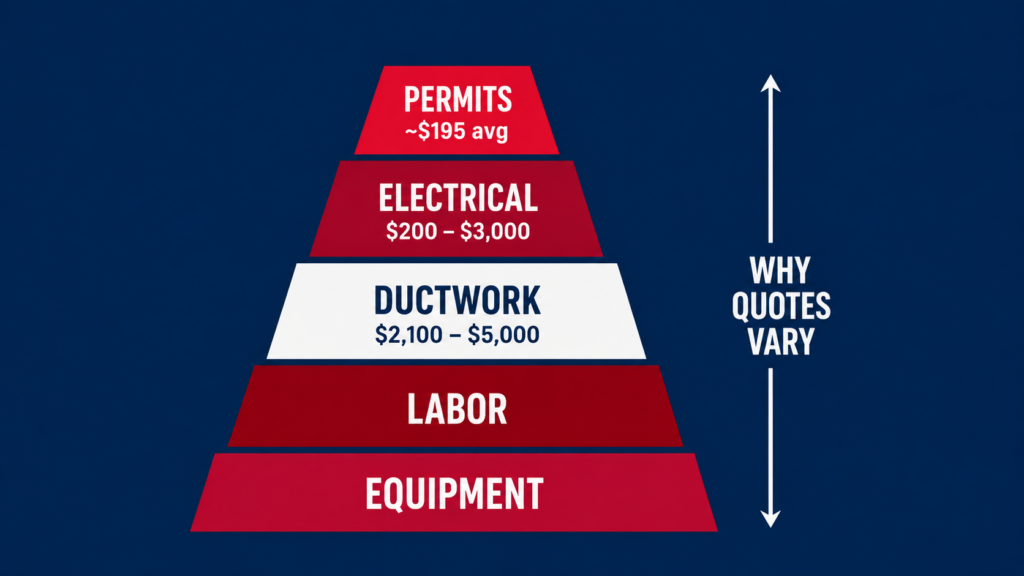
  • Ductwork. This is one of the biggest swing factors in Houston. Duct replacement here averages roughly $813 to $2,959, and whole-home replacement on a 2,000 to 3,000 square foot house can run $2,959 to $5,000. National full-system data shows ductwork adding around $2,100 to $4,000 on a 2,000 square foot home.
  • Matched components. The indoor coil and outdoor unit are engineered to work as a set. Pairing mismatched halves undercuts performance.
  • Labor. Installation covers more than payroll. It covers trucks, overhead, warranty handling, permitting, and the cost of standing behind the work if something needs a callback.
  • Electrical work. A dedicated circuit or new disconnect typically runs $200 to $800, and a panel upgrade can run $1,500 to $3,000.
  • Permits. The City of Houston charges a base fee plus a per-ton charge for a complete air conditioning system, and homeowners often see permit charges averaging around $195.

When you compare bids, ask each contractor what is included. A higher quote that covers proper ductwork, a permit, and a matched, AHRI-certified system may be a better value than a cheaper one that leaves those out.

Why correct system sizing matters more than homeowners think

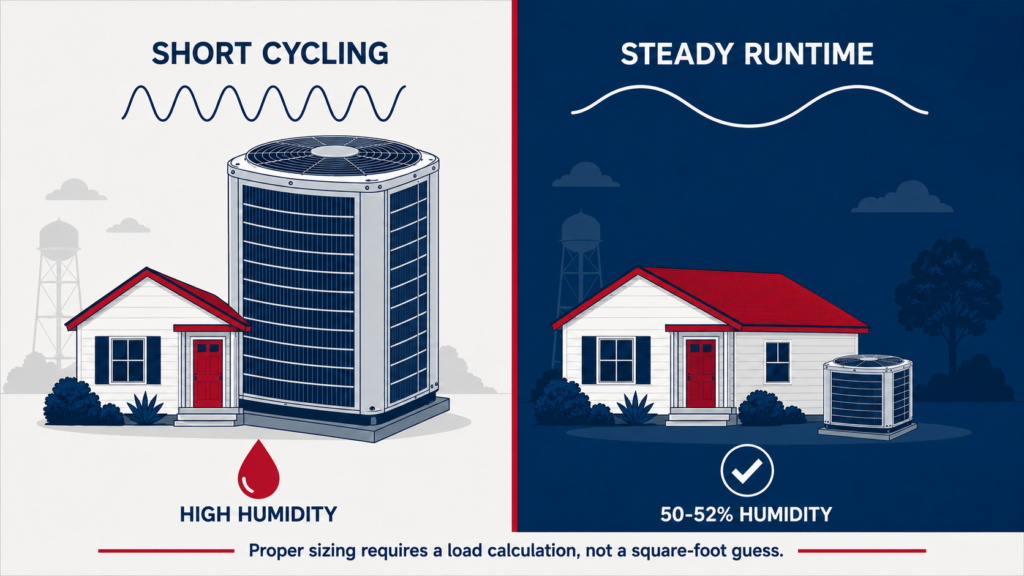
The most common mistake we see in the field is an oversized system. Most systems people buy are too large for the home they are cooling, and in Houston that is a real problem, not a safety margin.

An oversized air conditioner cools the house too quickly, then shuts off before it has run long enough to pull humidity out of the air. The federal Department of Energy is direct about this: an oversized unit won’t adequately remove humidity, which leaves indoor air feeling clammy even when the thermostat reads a comfortable temperature. In a humid climate like ours, that is a comfort problem you feel every day.

It is a cost problem too. A system that short-cycles, turning on and off in bursts of only a few minutes, runs less efficiently and drives up operating costs, and the constant starting and stopping adds wear that shortens equipment life. Federal guidance ties this directly to oversizing: a unit that is too large cools fast but cycles off before it does its job. That is why the Department of Energy stresses getting the size right in hot, humid climates rather than treating extra capacity as a safety margin.

The right way to size a system is a load calculation, not a square-foot guess or a “replace it with the same size that was here” shortcut. At Spring Branch, we run that calculation on the specific home rather than guessing. We have walked into houses with a unit several times larger than the roughly 2 tons the space actually needed, and the result was chronic humidity and the growth problems that come with it. The bigger equipment created the problem. It did not solve it.
Should the indoor coil be replaced with the outdoor unit?

Yes. Split systems are designed and rated as a matched indoor and outdoor pair, and the industry verifies those matches for a reason. The Air-Conditioning, Heating, and Refrigeration Institute (AHRI) describes the indoor coil and outdoor condensing unit as a coordinated team built to work together, and maintains a directory specifically so installers can confirm a given combination is a certified match.

When a contractor offers to replace only the outdoor unit on an older system to save you money, treat it with caution. Pairing a new condenser with an aging, mismatched coil can undercut the certified performance the system was rated for, and AHRI documentation can matter when you register equipment for its manufacturer warranty. The cleanest move is to ask any contractor for the AHRI reference number or certificate for the exact indoor and outdoor combination they are quoting, and to ask how that combination affects your warranty registration.

There is a narrow exception worth knowing. The EPA confirms that homeowners can legally repair legacy systems and even replace a single component, like a condensing unit or indoor coil, in some circumstances. What you cannot do is mix incompatible equipment, such as putting an R-410A condenser on a system built for the older R-22 refrigerant. If someone proposes a partial replacement, the question is not just price. It is whether the resulting combination is a certified, compatible match.

Repair or replace: when a new HVAC system actually makes sense

Replacing a system is the right call sometimes and premature other times. A replacement recommendation should come with evidence, not pressure.

ENERGY STAR’s general guidance is that replacement becomes defensible when an air conditioner or heat pump is more than 10 years old, or a furnace is more than 15 years old, especially when the equipment needs frequent repairs and energy bills are climbing. A common dividing line is when repair costs approach or exceed 50% of the cost to replace.
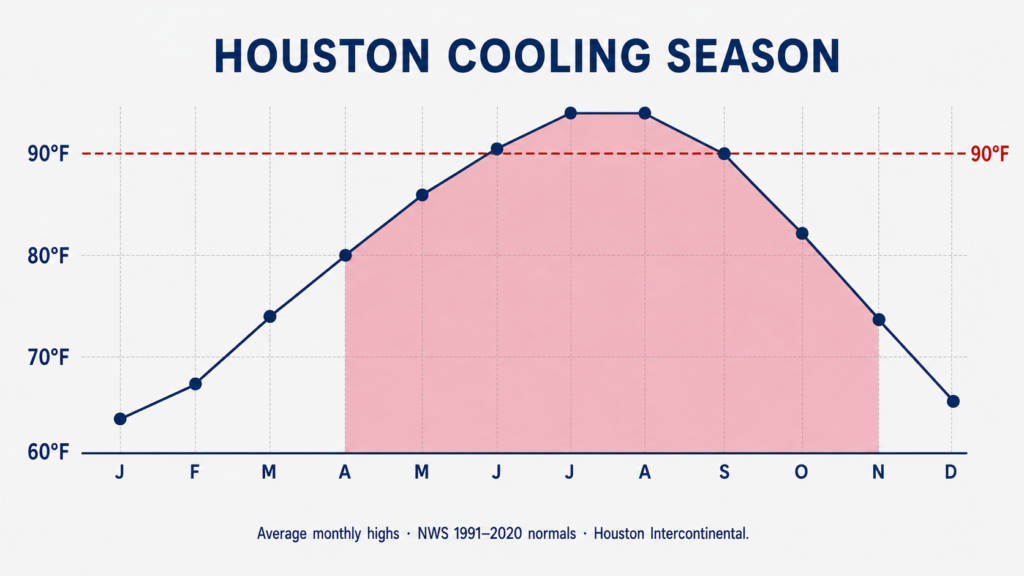
Houston systems run hard. Our cooling season stretches across most of the year, with average highs above 90°F from June through September, so a marginal system gets pushed harder here than in most of the country. That accelerates wear and makes the repair-versus-replace math worth taking seriously once a system passes the 10-year mark.

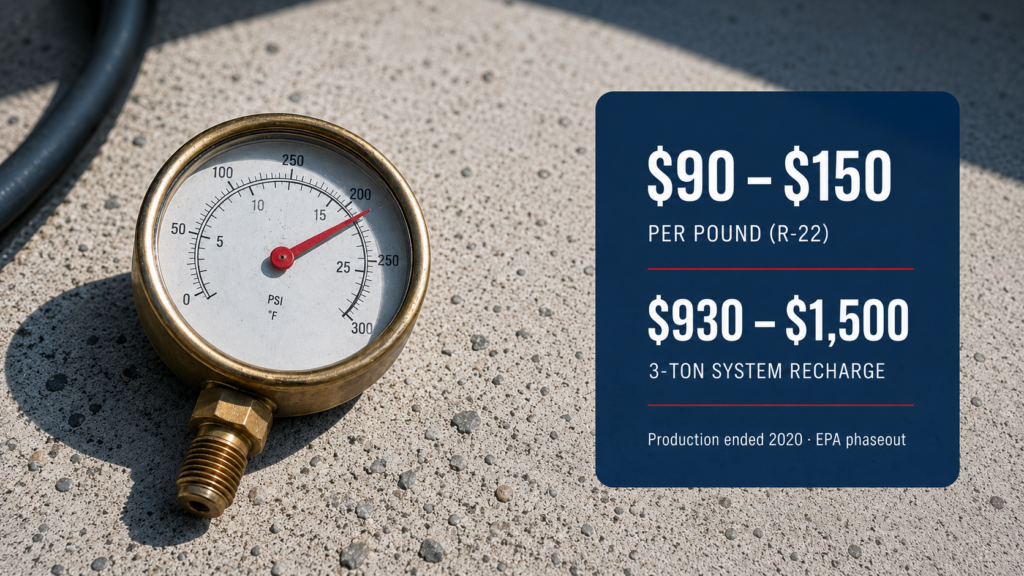
Refrigerant is the other factor that can tip an older system toward replacement. The EPA fully phased out new production and import of R-22, often called Freon, as of 2020, and that scarcity keeps pushing repair costs up. R-22 now runs roughly $90 to $150 per pound, and recharging a 3-ton system can cost $930 to $1,500 in refrigerant and labor alone. 
If your system uses R-22 and develops a leak, repeated repairs can stop making financial sense fast.

SituationRepair often makes senseReplacement often makes sense
System ageUnder 10 years (AC/heat pump)Over 10 years with recurring issues
Repair costWell under 50% of replacementApproaching or above 50% of replacement
RefrigerantR-410A, parts availableR-22 leak, refrigerant scarce and costly
Failure typeOne component, compatible fixMultiple aging components

A single failed part rarely forces a full replacement on its own. The decision depends on age, refrigerant type, total maintenance history, and whether a partial fix would create an uncertified or incompatible combination. We never tell a homeowner a system is dead. The honest question is whether repair or replacement makes more sense for the home in front of us.

How to read an HVAC quote and avoid getting oversold

Before you spend five figures, it is worth slowing down and reading the quote carefully. A few habits protect you:
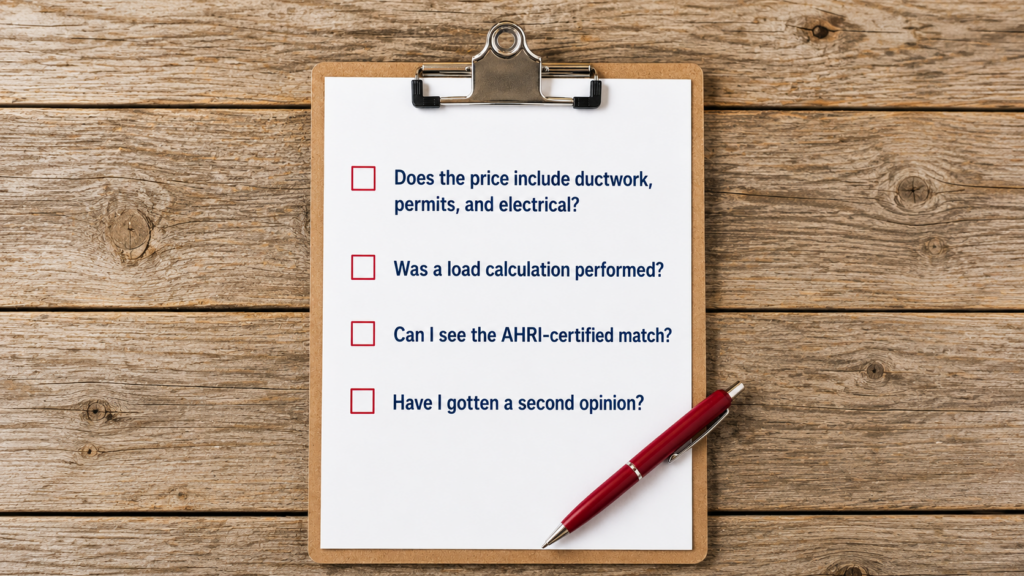
  • Ask what scope is included. Does the price cover ductwork, a permit, electrical work, and a matched system? A cheaper quote that leaves these out can cost more in the end.
  • Ask for a load calculation. If a contractor sizes your system by square footage alone or just matches what was there, that is a red flag. Proper sizing requires a calculation.
  • Ask for the AHRI-certified match. Request the reference number for the exact indoor and outdoor combination, and confirm how it affects your warranty.
  • Get a second opinion before a big replacement. A replacement recommendation should come with evidence you can see.

That last point is where we have seen homeowners save real money. We were once called for a second opinion after another company told a homeowner their entire system needed replacing because of biological growth throughout the unit and ductwork. We physically opened the evaporator coil, checked the blower assembly, and inspected the plenum and ductwork. Everything inside was clean. What the first company flagged as growth was surface residue on the exterior casing from normal condensation. The system did not need replacing. A few maintenance items, yes, but not a five-figure system. The lesson for any homeowner: you cannot judge what is inside a system from the outside, and you are entitled to a second look before you spend.

To be fair, premium equipment is not always an upsell. In a long, humid cooling season like Houston’s, two-stage and variable-speed systems make a legitimate case for better comfort and humidity control, and high-efficiency equipment can deliver real return when the AC runs much of the year. The goal is not to always buy the cheapest system. It is to buy the right system for your home, sized and matched correctly, at a fair price.

Financing a new HVAC system

A whole-system replacement is a significant expense, and financing helps many homeowners spread it out. For larger projects, we offer financing through Synchrony Financial, subject to credit approval, with approval typically completed on-site. It keeps a major replacement from having to be paid in full upfront.

Protecting your investment after installation

Two simple steps help a new system earn back what it cost. Register the equipment with the manufacturer inside its registration window, which on many systems can double the standard parts warranty. And keep up with consistent maintenance, which extends system life and catches small problems before they become expensive ones. Both cost little and protect a five-figure purchase.

Get an honest estimate in Houston

If you are weighing a new HVAC system, the best first step is a real load calculation and a straight estimate from someone who will tell you the truth about what your home needs. We provide free estimates across the Houston area, with no after-hours or weekend upcharges, and our NATE-certified technicians size every system to the specific home rather than guessing. Whether you need a full replacement or just a second opinion before spending five figures, reach out to our team and we will give you an honest assessment. You can also review our HVAC upgrade and replacement options, see how we approach selecting a new system, or weigh your repair-or-replace decision before you decide.

A complete HVAC system replacement in the Houston area typically costs $10,000 to $22,000 installed when new ductwork is part of the job, with most whole-system replacements landing in the low five figures. A national dataset of recent homeowner projects puts the 2026 average closer to $11,590 to $14,100, and a typical AC and gas furnace setup for a 2,000 to 2,500 square foot home averages around $13,430 before major add-ons. Ductwork, electrical work, premium equipment, and tricky installations push the number up from there.

At Spring Branch Air Conditioning & Heating, we’ve replaced systems for Houston-area homeowners since 1956, and we publish our own replacement pricing organized by system size and efficiency tier. We also tell people the truth about what they need, including the times they don’t need a full replacement at all. Real technicians work here, not professional salespeople, so this guide gives you straight numbers and the reasoning behind them, then shows you how to read a quote so you don’t get oversold on a five-figure decision.

What is the average cost of a new HVAC system in Houston?

For most Houston homes, a full system replacement falls in the low five figures. Here is how the most reliable sources line up:

SourceFigureWhat it covers
Houston metro estimate$10,000 to $22,000Complete HVAC replacement with new ductwork
2026 national average$11,590 to $14,100Full HVAC replacement, based on recent homeowner projects
2,000 to 2,500 sq. ft. homeAbout $13,430AC and gas furnace system before major add-ons
Simpler split-system change-out$3,750 to $7,400Narrower scope, not a whole-system job

The wide spread is the part that matters. The Houston metro range comes from an aggregator that localizes national project costs, while the $11,590 to $14,100 figure is drawn from roughly 56,000 real homeowner projects over six months. Both point to the same conclusion: budget in the low five figures for a typical whole-system replacement, and expect the final number to move based on the specifics of your home.

That low-end “$3,750 to $7,400” figure deserves a flag. It reflects a simpler split-system change-out, not a complete system replacement with ductwork and everything else. If a quote comes in well below the broader range, ask exactly what scope it includes before you assume you found a bargain.

HVAC replacement cost by system size and efficiency

Two factors drive the base equipment cost more than anything else: how big the system needs to be, measured in tons, and how efficient it is, measured in SEER2. Larger systems cost more because they use more material and bigger components. Higher-efficiency systems cost more upfront but use less energy over their life.

Equipment-only pricing climbs steadily with tonnage. National figures show roughly $2,100 for a 2-ton unit up to around $3,700 for a 5-ton unit, for the air conditioner alone. Those are equipment numbers, not installed system costs, so a finished Houston job lands well above them once you add the indoor unit, labor, materials, and permits.

Efficiency adds another layer. The federal minimum for new split-system air conditioners in the southern zone, which includes Houston, is now 14.3 SEER2. You can install at that floor or step up to higher-efficiency, two-stage, or variable-speed equipment. In Houston’s climate, that upgrade often pays back faster than it would in a cooler market, which we get into below.

We publish our own replacement pricing by system size and efficiency tier so homeowners can see real installed numbers rather than aggregator averages. The general shape of it: a smaller, single-speed system sits at the low end, and a larger, variable-speed system sits at the top. Asking for pricing laid out this way is a good habit with any contractor, because it lets you compare apples to apples.

What affects the cost of an HVAC replacement?

Two quotes for the “same size, same brand” system can still differ by thousands of dollars. Here is what moves the number:

  • System size (tonnage). Bigger systems cost more in equipment and labor. But bigger is not automatically better, which gets its own section below.
  • Efficiency rating (SEER2). Higher-efficiency equipment costs more upfront and saves more over time.
  • Ductwork. This is one of the biggest swing factors in Houston. Duct replacement here averages roughly $813 to $2,959, and whole-home replacement on a 2,000 to 3,000 square foot house can run $2,959 to $5,000. National full-system data shows ductwork adding around $2,100 to $4,000 on a 2,000 square foot home.
  • Matched components. The indoor coil and outdoor unit are engineered to work as a set. Pairing mismatched halves undercuts performance.
  • Labor. Installation covers more than payroll. It covers trucks, overhead, warranty handling, permitting, and the cost of standing behind the work if something needs a callback.
  • Electrical work. A dedicated circuit or new disconnect typically runs $200 to $800, and a panel upgrade can run $1,500 to $3,000.
  • Permits. The City of Houston charges a base fee plus a per-ton charge for a complete air conditioning system, and homeowners often see permit charges averaging around $195.

When you compare bids, ask each contractor what is included. A higher quote that covers proper ductwork, a permit, and a matched, AHRI-certified system may be a better value than a cheaper one that leaves those out.

Why correct system sizing matters more than homeowners think

The most common mistake we see in the field is an oversized system. Most systems people buy are too large for the home they are cooling, and in Houston that is a real problem, not a safety margin.

An oversized air conditioner cools the house too quickly, then shuts off before it has run long enough to pull humidity out of the air. The federal Department of Energy is direct about this: an oversized unit won’t adequately remove humidity, which leaves indoor air feeling clammy even when the thermostat reads a comfortable temperature. In a humid climate like ours, that is a comfort problem you feel every day.

It is a cost problem too. A system that short-cycles, turning on and off in bursts of only a few minutes, runs less efficiently and drives up operating costs, and the constant starting and stopping adds wear that shortens equipment life. Federal guidance ties this directly to oversizing: a unit that is too large cools fast but cycles off before it does its job. That is why the Department of Energy stresses getting the size right in hot, humid climates rather than treating extra capacity as a safety margin.

The right way to size a system is a load calculation, not a square-foot guess or a “replace it with the same size that was here” shortcut. At Spring Branch, we run that calculation on the specific home rather than guessing. We have walked into houses with a unit several times larger than the roughly 2 tons the space actually needed, and the result was chronic humidity and the growth problems that come with it. The bigger equipment created the problem. It did not solve it.

Should the indoor coil be replaced with the outdoor unit?

Yes. Split systems are designed and rated as a matched indoor and outdoor pair, and the industry verifies those matches for a reason. The Air-Conditioning, Heating, and Refrigeration Institute (AHRI) describes the indoor coil and outdoor condensing unit as a coordinated team built to work together, and maintains a directory specifically so installers can confirm a given combination is a certified match.

When a contractor offers to replace only the outdoor unit on an older system to save you money, treat it with caution. Pairing a new condenser with an aging, mismatched coil can undercut the certified performance the system was rated for, and AHRI documentation can matter when you register equipment for its manufacturer warranty. The cleanest move is to ask any contractor for the AHRI reference number or certificate for the exact indoor and outdoor combination they are quoting, and to ask how that combination affects your warranty registration.

There is a narrow exception worth knowing. The EPA confirms that homeowners can legally repair legacy systems and even replace a single component, like a condensing unit or indoor coil, in some circumstances. What you cannot do is mix incompatible equipment, such as putting an R-410A condenser on a system built for the older R-22 refrigerant. If someone proposes a partial replacement, the question is not just price. It is whether the resulting combination is a certified, compatible match.

Repair or replace: when a new HVAC system actually makes sense

Replacing a system is the right call sometimes and premature other times. A replacement recommendation should come with evidence, not pressure.

ENERGY STAR’s general guidance is that replacement becomes defensible when an air conditioner or heat pump is more than 10 years old, or a furnace is more than 15 years old, especially when the equipment needs frequent repairs and energy bills are climbing. A common dividing line is when repair costs approach or exceed 50% of the cost to replace.

Houston systems run hard. Our cooling season stretches across most of the year, with average highs above 90°F from June through September, so a marginal system gets pushed harder here than in most of the country. That accelerates wear and makes the repair-versus-replace math worth taking seriously once a system passes the 10-year mark.

Refrigerant is the other factor that can tip an older system toward replacement. The EPA fully phased out new production and import of R-22, often called Freon, as of 2020, and that scarcity keeps pushing repair costs up. R-22 now runs roughly $90 to $150 per pound, and recharging a 3-ton system can cost $930 to $1,500 in refrigerant and labor alone. 

If your system uses R-22 and develops a leak, repeated repairs can stop making financial sense fast.

SituationRepair often makes senseReplacement often makes sense
System ageUnder 10 years (AC/heat pump)Over 10 years with recurring issues
Repair costWell under 50% of replacementApproaching or above 50% of replacement
RefrigerantR-410A, parts availableR-22 leak, refrigerant scarce and costly
Failure typeOne component, compatible fixMultiple aging components

A single failed part rarely forces a full replacement on its own. The decision depends on age, refrigerant type, total maintenance history, and whether a partial fix would create an uncertified or incompatible combination. We never tell a homeowner a system is dead. The honest question is whether repair or replacement makes more sense for the home in front of us.

How to read an HVAC quote and avoid getting oversold

Before you spend five figures, it is worth slowing down and reading the quote carefully. A few habits protect you:

  • Ask what scope is included. Does the price cover ductwork, a permit, electrical work, and a matched system? A cheaper quote that leaves these out can cost more in the end.
  • Ask for a load calculation. If a contractor sizes your system by square footage alone or just matches what was there, that is a red flag. Proper sizing requires a calculation.
  • Ask for the AHRI-certified match. Request the reference number for the exact indoor and outdoor combination, and confirm how it affects your warranty.
  • Get a second opinion before a big replacement. A replacement recommendation should come with evidence you can see.

That last point is where we have seen homeowners save real money. We were once called for a second opinion after another company told a homeowner their entire system needed replacing because of biological growth throughout the unit and ductwork. We physically opened the evaporator coil, checked the blower assembly, and inspected the plenum and ductwork. Everything inside was clean. What the first company flagged as growth was surface residue on the exterior casing from normal condensation. The system did not need replacing. A few maintenance items, yes, but not a five-figure system. The lesson for any homeowner: you cannot judge what is inside a system from the outside, and you are entitled to a second look before you spend.

To be fair, premium equipment is not always an upsell. In a long, humid cooling season like Houston’s, two-stage and variable-speed systems make a legitimate case for better comfort and humidity control, and high-efficiency equipment can deliver real return when the AC runs much of the year. The goal is not to always buy the cheapest system. It is to buy the right system for your home, sized and matched correctly, at a fair price.

Financing a new HVAC system

A whole-system replacement is a significant expense, and financing helps many homeowners spread it out. For larger projects, we offer financing through Synchrony Financial, subject to credit approval, with approval typically completed on-site. It keeps a major replacement from having to be paid in full upfront.

Protecting your investment after installation

Two simple steps help a new system earn back what it cost. Register the equipment with the manufacturer inside its registration window, which on many systems can double the standard parts warranty. And keep up with consistent maintenance, which extends system life and catches small problems before they become expensive ones. Both cost little and protect a five-figure purchase.

Get an honest estimate in Houston

If you are weighing a new HVAC system, the best first step is a real load calculation and a straight estimate from someone who will tell you the truth about what your home needs. We provide free estimates across the Houston area, with no after-hours or weekend upcharges, and our NATE-certified technicians size every system to the specific home rather than guessing. Whether you need a full replacement or just a second opinion before spending five figures, reach out to our team and we will give you an honest assessment. You can also review our HVAC upgrade and replacement options, see how we approach selecting a new system, or weigh your repair-or-replace decision before you decide.

Previous Post

Contact Spring Branch AC

Free estimates available. Licensed, insured, and ready to help.

Copyright © 2026 Spring Branch AC

Product logos and images are the property of their respective manufacturers

Scroll to Top